

/fdata%2F2453167%2Favatar-blog-1073688003-tmpphpuHSn6z.jpeg)
LIVRE:The Project Gutenberg EBook of Morocco, by S.L. Bensusan
A VILLAGE AT DUKALA
I could do no more than deliver messages of consolation to the poor tribesmen, who sat in a semicircle, patient in the quivering heat. The old story of goodwill and inability had to be told again, and I never saw men more dejected. At the moment of leave-taking, however, I remembered that we had some empty mineral-water bottles and a large collection of gunmaker's circulars, that had been used as padding for a case of cartridges. So I distributed the circulars and empty bottles among the protection hunters, and they received them with wonder and delight. When I turned to take a last look round, the pages that had pictures of guns were being passed reverently from hand to hand; to outward seeming the farmers had forgotten their trouble. Thus easily may kindnesses be wrought among the truly simple of this world.
The market of Sidi B'noor is famous for its sales of slaves and horses,[15] but I remember it best by its swarm of blue rock-pigeons and sparrow-hawks, that seemed to live side by side in the walls surrounding the saint's white tomb. For reasons best known to themselves they lived without quarrelling, perhaps because the saint was a man of peace. Surely a sparrow-hawk in our island would not build his nest and live in perfect amity with pigeons. But, as is well known, the influence of the saintly endures after the flesh of the saint has returned to the dust whence it came.
The difference between Dukala and R'hamna, two adjacent provinces, is very marked. All that the first enjoys the second lacks. We left the fertile lands for great stony plains, wind-swept, bare and dry. Skeletons of camels, mules, and donkeys told their story of past sufferings, and the water supply was as scanty as the herbage upon which the R'hamna flocks fare so poorly. In place of prosperous douars, set in orchards amid rich arable land, there were Government n'zalas at long intervals in the waste, with wattled huts, and lean, hungry tribesmen, whose poverty was as plain to see as their ribs. Neither Basha nor Kaid could well grow fat now in such a place, and yet there was a time when R'hamna was a thriving province after its kind. But it had a warlike people and fierce, to whom the temptation of plundering the caravans that made their way to the Southern capital was irresistible. So the Court Elevated by Allah, taking advantage of a brief interval of peace, turned its forces loose against R'hamna early in the last decade of the nineteenth century. From end to end of its plains the powder "spoke," and the burning douars lighted the roads that their owners had plundered so often. Neither old nor young were spared, and great basketsful of human heads were sent to Red Marrakesh, to be spiked upon the wall by the J'maa Effina. When the desolation was complete from end to end of the province, the Shareefian troops were withdrawn, the few remaining folk of R'hamna were sent north and south to other provinces, the n'zalas were established in place of the forgotten douars, and the Elevated Court knew that there would be no more complaints. That was Mulai el Hassan's method of ruling—may Allah have pardoned him—and his grand wazeer's after him. It is perhaps the only method that is truly understood by the people in Morocco. R'hamna reminded me of the wildest and bleakest parts of Palestine, and when the Maalem said solemnly it was tenanted by djinoon since the insurrection, I felt he must certainly be right.
One evening we met an interesting procession. An old farmer was making his way from the jurisdiction of the local kaid. His "house" consisted of two wives and three children. A camel, whose sneering contempt for mankind was very noticeable, shuffled cumbrously beneath a very heavy load of mattresses, looms, rugs, copper kettles, sacks of corn, and other impedimenta. The wives, veiled to the eyes, rode on mules, each carrying a young child; the third child, a boy, walked by his father's side. The barley harvest had not been good in their part of the country, so after selling what he could, the old man had packed his goods on to the camel's back and was flying from the tax-gatherer. To be sure, he might meet robbers on the way to the province of M'touga, which was his destination, but they would do no more than the kaid of his own district; they might even do less. He had been many days upon the road, and was quaintly hopeful. I could not help thinking of prosperous men one meets at home, who declare, in the intervals of a costly dinner, that the Income Tax is an imposition that justifies the strongest protest, even to the point of repudiating the Government that puts it up by twopence in the pound. Had anybody been able to assure this old wanderer that his kaid or khalifa would be content with half the produce of his land, how cheerfully would he have returned to his native douar, how readily he would have—devised plans to avoid payment. A little later the track would be trodden by other families, moving, like the true Bedouins, in search of fresh pasture. It is the habit of the country to leave land to lie fallow when it has yielded a few crops.
There were days when the mirage did for the plain the work that man had neglected. It set great cities on the waste land as though for our sole benefit. I saw walls and battlements, stately mosques, cool gardens, and rivers where caravans of camels halted for rest and water. Several times we were deceived and hurried on, only to find that the wonder city, like the ignis fatuus of our own marshlands, receded as we approached and finally melted away altogether. Then the Maalem, after taking refuge with Allah from Satan the Stoned, who set false cities before the eyes of tired travellers, would revile the mules and horses for needing a mirage to urge them on the way; he would insult the fair fame of their mothers and swear that their sires were such beasts as no Believer would bestride. It is a fact that when the Maalem lashed our animals with his tongue they made haste to improve their pace, if only for a few minutes, and Salam, listening with an expression of some concern at the sad family history of the beasts—he had a stinging tongue for oaths himself—assured me that their sense of shame hurried them on. Certainly no sense of shame, or duty, or even compassion, ever moved the Maalem. By night he would repair to the kitchen tent and smoke kief or eat haschisch, but the troubles of preparing beds and supper did not worry him.
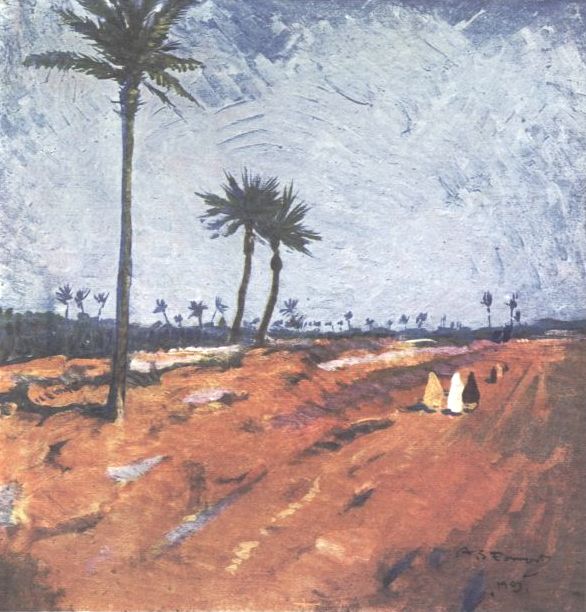
"Until the feast is prepared, why summon the guest," he said on a night when the worthy M'Barak, opening his lips for once, remonstrated with him. That evening the feast consisted of some soup made from meat tablets, and two chickens purchased for elevenpence the pair, of a market woman we met on the road. Yet if it was not the feast the Maalem's fancy painted it, our long hours in the open air had served to make it more pleasant than many a more elaborate meal.
We rode one morning through the valley of the Little Hills, once a place of unrest notorious by reason of several murders committed there, and deserted now by everything save a few birds of prey. There were gloomy rocks on all sides, the dry bed of a forgotten river offered us an uncomfortable and often perilous path, and we passed several cairns of small stones. The Maalem left his mule in order to pick up stones and add one to each cairn, and as he did so he cursed Satan with great fluency.[16]
It was a great relief to leave the Little Hills and emerge on to the plains of Hillreeli beyond. We had not far to go then before the view opened out, the haze in the far distance took faint shape of a city surrounded by a forest of palms on the western side, a great town with the minarets of many mosques rising from it. At this first view of Red Marrakesh, Salam, the Maalem, and M'Barak extolled Allah, who had renewed to them the sight of Yusuf ibn Tachfin's thousand-year-old city. Then they praised Sidi bel Abbas, the city's patron saint, who by reason of his love for righteous deeds stood on one leg for forty years, praying diligently all the time.
We each and all rendered praise and thanks after our separate fashions, and for me, I lit my last cigarette, careless of the future and well pleased.
[13] As the gnat settles he cries, "Habibi," i.e. "O my beloved." His, one fears, is but a carnal affection.
[14] I.e. Wives and children, to whom no Moor refers by name.
[15] It is said to be the largest market in the Sultan's dominions. As many as two thousand camels have been counted at one of the weekly gatherings here.
[16] The cairns are met frequently in Morocco. Some mark the place from which the traveller may obtain his first view of a near city; others are raised to show where a murder was committed. The cairns in the Little Hills are of the former kind.
IN RED MARRAKESH
CHAPTER V
Whose portals are alternate Night and Day,
How Sultán after Sultán with his pomp
Abode his destined hour and went his way.
There are certain cities that cannot be approached for the first time by any sympathetic traveller without a sense of solemnity and reverence that is not far removed from awe. Athens, Rome, Constantinople, Damascus, and Jerusalem may be cited as examples; each in its turn has filled me with great wonder and deep joy. But all of these are to be reached nowadays by the railway, that great modern purge of sensibility. Even Jerusalem is not exempt. A single line stretches from Jaffa by the sea to the very gates of the Holy City, playing hide-and-seek among the mountains of Judæa by the way, because the Turk was too poor to tunnel a direct path.
In Morocco, on the other hand, the railway is still unknown. He who seeks any of the country's inland cities must take horse or mule, camel or donkey, or, as a last resource, be content with a staff to aid him, and walk. Whether he fare to Fez, the city of Mulai Idrees, in which, an old writer assures us, "all the beauties of the earth are united"; or to Mequinez, where great Mulai Ismail kept a stream of human blood flowing constantly from his palace that all might know he ruled; or to Red Marrakesh, which Yusuf ibn Tachfin built nine hundred years ago,—his own exertion must convoy him. There must be days and nights of scant fare and small comfort, with all those hundred and one happenings of the road that make for pleasant memories. So far as I have been able to gather in the nine years that have passed since I first visited Morocco, one road is like another road, unless you have the Moghrebbin Arabic at your command and can go off the beaten track in Moorish dress. Walter Harris, the resourceful traveller and Times correspondent, did this when he sought the oases of Tafilalt, so also, in his fashion, did R.B. Cunninghame Graham when he tried in vain to reach Tarudant, and set out the record of his failure in one of the most fascinating travel books published since Eothen.[17]
For the rank and file of us the Government roads and the harmless necessary soldier must suffice, until the Gordian knot of Morocco's future has been untied or cut. Then perhaps, as a result of French pacific penetration, flying railway trains loaded with tourists, guide-book in hand and camera at the ready, will pierce the secret places of the land, and men will speak of "doing" Morocco, as they "do" other countries in their rush across the world, seeing all the stereotyped sights and appreciating none. For the present, by Allah's grace, matters are quite otherwise.
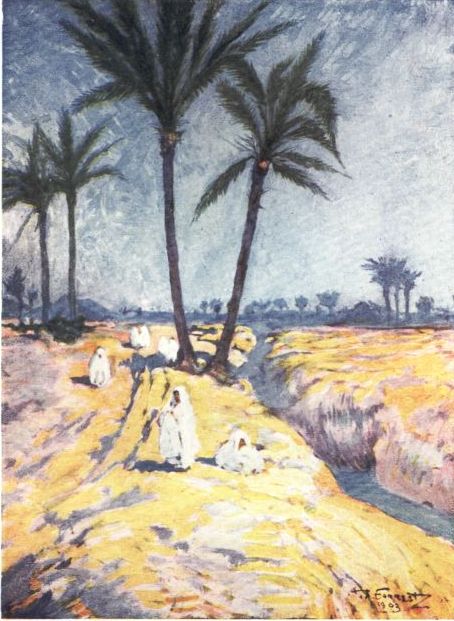
Marrakesh unfolded its beauties to us slowly and one by one as we pushed horses and mules into a canter over the level plains of Hillreeli. Forests of date-palm took definite shape; certain mosques, those of Sidi ben Yusuf and Bab Dukala, stood out clearly before us without the aid of glasses, but the Library mosque dominated the landscape by reason of the Kutubia tower by its side. The Atlas Mountains came out of the clouds and revealed the snows that would soon melt and set every southern river aflood, and then the town began to show limits to the east and west where, at first, there was nothing but haze. One or two caravans passed us, northward bound, their leaders hoping against hope that the Pretender, the "dog-descended," as a Susi trader called him, would not stand between them and the Sultan's camp, where the profits of the journey lay. By this time we could see the old grey wall of Marrakesh more plainly, with towers here and there, ruinous as the wall itself, and storks' nests on the battlements, their red-legged inhabitants fulfilling the duty of sentries. To the right, beyond the town, the great rock of Djebel Geelez suggested infinite possibilities in days to come, when some conqueror armed with modern weapons and a pacific mission should wish to bombard the walls in the sacred cause of civilisation. Then the view was lost in the date-palm forest, through which tiny tributaries of the Tensift run babbling over the red earth, while the kingfisher or dragon-fly, "a ray of living light," flashes over the shallow water, and young storks take their first lessons in the art of looking after themselves.
When a Moor has amassed wealth he praises God, builds a palace, and plants a garden; or, is suspected, accused—despotic authority is not particular—and cast into prison! In and round Marrakesh many Moors have gained riches and some have held them. The gardens stretch for miles. There are the far-spreading Augdal plantations of the Sultans of Morocco, in part public and elsewhere so private that to intrude would be to court death. The name signifies "the Maze," and they are said to justify it. In the outer or public grounds of this vast pleasaunce the fruit is sold by auction to the merchants of the city in late spring, when blossoming time is over, and, after the sale, buyers must watch and guard the trees until harvest brings them their reward.
We rode past the low-walled gardens, where pomegranate and apricot trees were flowering, and strange birds I did not know sang in the deep shade. Doves flitted from branch to branch, bee-eaters darted about among mulberry and almond trees. There was an overpowering fragrance from the orange groves, where blossom and unplucked fruit showed side by side; the jessamine bushes were scarcely less fragrant. Spreading fig-trees called every passer to enjoy their shade, and the little rivulets, born of the Tensift's winter floods to sparkle through the spring and die in June, were fringed with willows. It was delightful to draw rein and listen to the plashing of water and the cooing of doves, while trying in vain to recognise the most exquisite among many sweet scents.
Under one of the fig-trees in a garden three Moors sat at tea. A carpet was spread, and I caught a glimpse of the copper kettle, the squat charcoal brazier tended by a slave, the quaint little coffer filled no doubt with fine green tea, the porcelain dish of cakes. It was a quite pleasing picture, at which, had courtesy permitted, I would have enjoyed more than a brief glance.
The claim of the Moors upon our sympathy and admiration is made greater by reason of their love for gardens. As a matter of fact, their devotion may be due in part to the profit yielded by the fruit, but one could afford to forget that fact for the time being, when Nature seemed to be giving praise to the Master of all seasons for the goodly gifts of the spring.
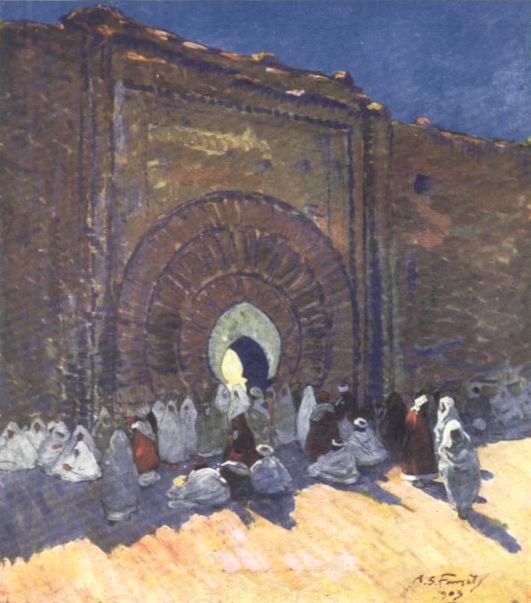
We crossed the Tensift by the bridge, one of the very few to be found in Southern Morocco. It has nearly thirty arches, all dilapidated as the city walls themselves, yet possessing their curious gift of endurance. Even the natives realise that their bridge is crumbling into uselessness, after nearly eight centuries of service, but they do no more than shrug their shoulders, as though to cast off the burden of responsibility and give it to destiny. On the outskirts of the town, where gardens end and open market-squares lead to the gates, a small group of children gathered to watch the strangers with an interest in which fear played its part. We waited now to see the baggage animals before us, and then M'Barak led the way past the mosque at the side of the Bab el Khamees and through the brass-covered doors that were brought by the Moors from Spain. Within the Khamees gate, narrow streets with windowless walls frowning on either side shut out all view, save that which lay immediately before us.
No untrained eye can follow the winding maze of streets in Marrakesh, and it is from the Moors we learn that the town, like ancient Gaul of Cæsar's Commentaries, has three well defined divisions. The Kasbah is the official quarter, where the soldiers and governing officials have their home, and the prison called Hib Misbah receives all evil-doers, and men whose luck is ill. The Madinah is the general Moorish quarter, and embraces the Kaisariyah or bazaar district, where the streets are parallel, well cleaned, thatched with palm and palmetto against the light, and barred with a chain at either end to keep the animals from entering. The Mellah (literally "salted place") is the third great division of Marrakesh, and is the Jewish quarter. In this district, or just beyond it, are a few streets that seem reserved to the descendants of Mulai Ismail's black guards, from whom our word "blackguard" should have come to us, but did not. Within these divisions streets, irregular and without a name, turn and twist in manner most bewildering, until none save old residents may hope to know their way about. Pavements are unknown, drainage is in its most dangerous infancy, the rainy season piles mud in every direction, and, as though to test the principle embodied in the homoeopathic theory, the Marrakshis heap rubbish and refuse in every street, where it decomposes until the enlightened authorities who dwell in the Kasbah think to give orders for its removal. Then certain men set out with donkeys and carry the sweepings of the gutters beyond the gates.[18] This work is taken seriously in the Madinah, but in the Mellah it is shamefully neglected, and I have ridden through whole streets in the last-named quarter searching vainly for a place clean enough to permit of dismounting. Happily, or unhappily, as you will, the inhabitants are inured from birth to a state of things that must cause the weaklings to pay heavy toll to Death, the Lord who rules even Sultans.
I had little thought to spare for such matters as we rode into Marrakesh for the first time. The spell of the city was overmastering. It is certainly the most African city in Morocco to-day, almost the last survivor of the changes that began in the latter half of the nineteenth century, and have brought the Dark Continent from end to end within the sphere of European influence. Fez and Mequinez are cities of fair men, while here on every side one recognised the influence of the Soudan and the country beyond the great desert. Not only have the wives and concubines brought from beyond the great sand sea darkened the skin of the present generation of the Marrakshis, but they have given to most if not to all a suggestion of relationship to the negro races that is not to be seen in any other Moorish city I have visited. It is not a suggestion of fanaticism or intolerance. By their action as well as their appearance one knew most of the passers for friends rather than enemies. They would gratify their curiosity at our expense as we gratified ours at theirs, convinced that all Europeans are harmless, uncivilised folk from a far land, where people smoke tobacco, drink wine, suffer their women-folk to go unveiled, and live without the True Faith.
Marrakesh, like all other inland cities of Morocco, has neither hotel nor guest-house. It boasts some large fandaks, notably that of Hadj Larbi, where the caravans from the desert send their merchandise and chief merchants, but no sane European will choose to seek shelter in a fandak in Morocco unless there is no better place available. There are clean fandaks in Sunset Land, but they are few and you must travel far to find them. I had letters to the chief civilian resident of Marrakesh, Sidi Boubikir, British Political Agent, millionaire, land-owner, financier, builder of palaces, politician, statesman, and friend of all Englishmen who are well recommended to his care. I had heard much of the clever old Moor, who was born in very poor surroundings, started life as a camel driver, and is now the wealthiest and most powerful unofficial resident in Southern Morocco, if not in all the Moghreb, so I bade M'Barak find him without delay. The first person questioned directed us to one of Boubikir's fandaks, and by its gate, in a narrow lane, where camels jostled the camp-mules until they nearly foundered in the underlying filth, we found the celebrated man sitting within the porch, on an old packing-case.
He looked up for a brief moment when the kaid dismounted and handed him my letter, and I saw a long, closely-shaven face, lighted by a pair of grey eyes that seemed much younger than the head in which they were set, and perfectly inscrutable. He read the letter, which was in Arabic, from end to end, and then gave me stately greeting.
"You are very welcome," he said. "My house and all it holds are yours."
I replied that we wanted nothing more than a modest shelter for the days of our sojourn in the city. He nodded.
"Had you advised me of your visit in time," he said, "my best house should have been prepared. Now I will send with you my steward, who has the keys of all my houses. Choose which you will have." I thanked him, the steward appeared, a stout, well-favoured man, whose djellaba was finer than his master's. Sidi Boubikir pointed to certain keys, and at a word several servants gathered about us. The old man said that he rejoiced to serve the friend of his friends, and would look forward to seeing me during our stay. Then we followed into an ill-seeming lane, now growing dark with the fall of evening.
We turned down an alley more muddy than the one just left behind, passed under an arch by a fruit stall with a covering of tattered palmetto, caught a brief glimpse of a mosque minaret, and heard the mueddin calling the Faithful to evening prayer. In the shadow of the mosque, at the corner of the high-walled lane, there was a heavy metal-studded door. The steward thrust a key into its lock, turned it, and we passed down a passage into an open patio. It was a silent place, beyond the reach of the street echoes; there were four rooms built round the patio on the ground floor, and three or four above. One side of the tower of the minaret was visible from the courtyard, but apart from that the place was nowhere overlooked. To be sure, it was very dirty, but I had an idea that the steward had brought his men out for business, not for an evening stroll, so I bade Salam assure him that this place, known to the Marrakshis as Dar al Kasdir,[19] would serve our purposes.
A thundering knock at the gate announced a visitor, one of Sidi Boubikir's elder sons, a civil, kindly-looking Moor, whose face inspired confidence. Advised of our choice he suggested we should take a stroll while the men cleaned and prepared the patio and the rooms opening upon it. Then the mules, resting for the time in his father's fandak, would bring their burdens home, and we could enjoy our well-earned rest.
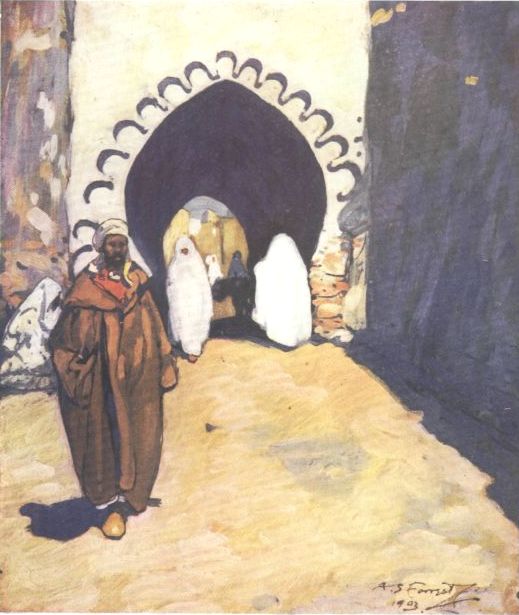
We took this good counsel, and on our return an hour later, a very complete transformation had been effected. Palmetto brooms, and water brought from an adjacent well, had made the floor look clean and clear. The warmth of the air had dried everything, the pack-mules had been relieved of their load and sent back to the stable. Two little earthen braziers full of charcoal were glowing merrily under the influence of the bellows that M'Barak wielded skilfully, and two earthen jars of water with palm leaves for corks had been brought in by our host's servants. In another hour the camp beds were unpacked and made up, a rug was set on the bedroom floor, and the little table and chairs were put in the middle of the patio. From the alcove where Salam squatted behind the twin fires came the pleasant scent of supper; M'Barak, his well-beloved gun at his side, sat silent and thoughtful in another corner, and the tiny clay bowl of the Maalem's long wooden kief pipe was comfortably aglow.
There was a timid knock at the door, the soldier opened it and admitted the shareef. I do not know his name nor whence he came, but he walked up to Salam, greeted him affectionately, and offered his services while we were in the city. Twenty years old perhaps, at an outside estimate, very tall and thin and poorly clad, the shareef was not the least interesting figure I met in Marrakesh. A shareef is a saint in Morocco as in every other country of Islam, and his title implies descent from Mohammed. He may be very poor indeed, but he is more or less holy, devout men kiss the hem of his djellaba, no matter how dirty or ragged it may be, and none may curse a shareef's ancestors, for the Prophet was one of them. His youthful holiness had known Salam in Fez, and had caught sight of him by Boubikir's fandak in the early afternoon. Salam, himself a chief in his own land, though fallen on evil days then and on worse ones since, welcomed the newcomer and brought his offer to me, adding the significant information that the young shareef, who was too proud to beg, had not tasted food in the past forty-eight hours. He had then owed a meal to some Moor, who, following a well-known custom, had set a bowl of food outside his house to conciliate devils. I accepted the proffered service, and had no occasion to regret my action. The young Moor was never in the way and never out of the way, he went cheerfully on errands to all parts of the city, fetched and carried without complaint, and yet never lost the splendid dignity that seemed to justify his claim to saintship.
So we took our ease in the open patio, and the shareef's long fast was broken, and the stars came to the aid of our lanterns, and when supper was over I was well content to sit and smoke, while Salam, M'Barak, the Maalem, and the shareef sat silent round the glowing charcoal, perhaps too tired to talk. It was very pleasant to feel at home after two or three weeks under canvas below Mediunah and along the southern road.
The Maalem rose at last, somewhat unsteadily after his debauch of kief. He moved to where our provisions were stocked and took oil and bread from the store. Then he sought the corner of the wall by the doorway and poured out a little oil and scattered crumbs, repeating the performance at the far end of the patio. This duty done, he bade Salam tell me that it was a peace-offering to the souls of the departed who had inhabited this house before we came to it. I apprehend they might have resented the presence of the Infidel had they not been soothed by the Maalem's little attention. He was ever a firm believer in djinoon, and exorcised them with unfailing regularity. The abuse he heaped on Satan must have added largely to the burden of sorrows under which we are assured the fallen angel carries out his appointed work. He had been profuse in his prayers and curses when we entered the barren pathway of the Little Hills behind the plains of Hillreeli, and there were times when I had felt quite sorry for Satan. Oblation offered to the house spirits, the Maalem asked for his money, the half due at the journey's end, sober enough, despite the kief, to count the dollars carefully, and make his farewell with courteous eloquence. I parted with him with no little regret, and look forward with keen pleasure to the day when I shall summon him once again from the bakehouse of Djedida to bring his mules and guide me over the open road, perchance to some destination more remote. I think he will come willingly, and that the journey will be a happy one. The shareef drew the heavy bolt behind the Maalem, and we sought our beds.
It was a brief night's rest. The voice of the mueddin, chanting the call to prayer and the Shehad,[20] roused me again, refreshed. The night was passing; even as the sonorous voice of the unseen chanted his inspiring "Allah Akbar," it was yielding place to the moments when "the Wolf-tail[21] sweeps the paling east."
I looked out of my little room that opened on to the patio. The arch of heaven was swept and garnished, and from "depths blown clear of cloud" great stars were shining whitely. The breeze of early morning stirred, penetrating our barred outer gates, and bringing a subtle fragrance from the beflowered groves that lie beyond the city. It had a freshness that demanded from one, in tones too seductive for denial, prompt action. Moreover, we had been rising before daylight for some days past in order that we might cover a respectable distance before the Enemy should begin to blaze intolerably above our heads, commanding us to seek the shade of some chance fig-tree or saint's tomb.
So I roused Salam, and together we drew the creaking bolts, bringing the kaid to his feet with a jump. There was plenty of time for explanation, because he always carried his gun, at best a harmless weapon, in the old flannel case secured by half a dozen pieces of string, with knots that defied haste. He warned us not to go out, since the djinoon were always abroad in the streets before daylight; but, seeing our minds set, he bolted the door upon us, as though to keep them from the Dar al Kasdir, and probably returned to his slumbers.
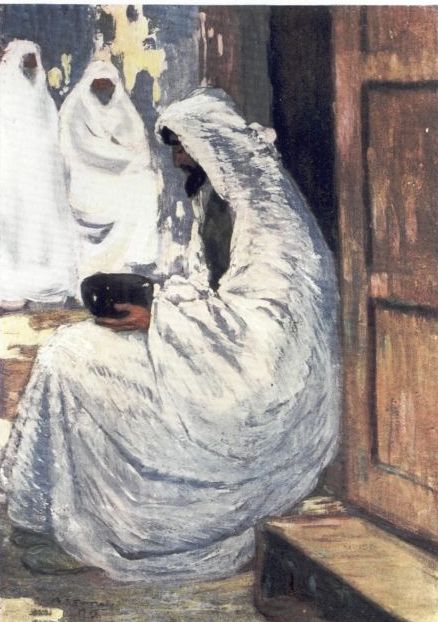
Beyond the house, in a faint glow that was already paling the stars, the African city, well-nigh a thousand years old, assumed its most mysterious aspect. The high walls on either side of the roads, innocent of casements as of glass, seemed, in the uncertain light, to be tinted with violet amid their dull grey. The silence was complete and weird. Never a cry from man or beast removed the first impression that this was a city of the dead. The entrances of the bazaars in the Kaisariyah, to which we turned, were barred and bolted, their guardians sat motionless, covered in white djellabas, that looked like shrouds. The city's seven gates were fast closed, though doubtless there were long files of camels and market men waiting patiently without. The great mansions of the wazeers and the green-tiled palace of Mulai Abd-el-Aziz—Our Victorious Master the Sultan—seemed unsubstantial as one of those cities that the mirage had set before us in the heart of the R'hamna plains. Salam, the untutored man from the far Riff country, felt the spell of the silent morning hour. It was a primitive appeal, to which he responded instantly, moving quietly by my side without a word.
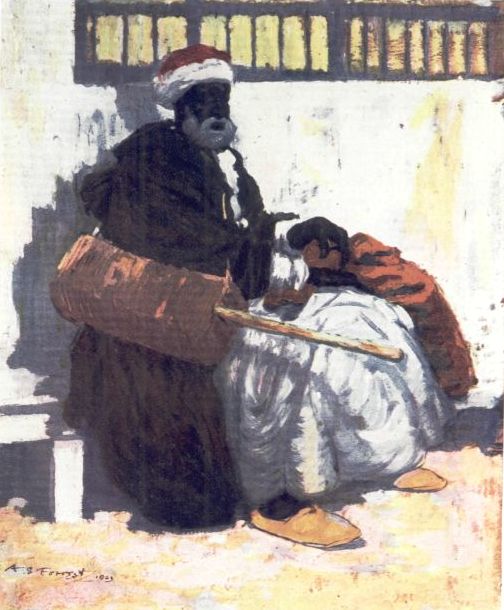
"O my masters, give charity; Allah helps helpers!" A blind beggar, sitting by the gate, like Bartimæus of old, thrust his withered hand before me. Lightly though we had walked, his keen ear had known the difference in sound between the native slipper and the European boot. It had roused him from his slumbers, and he had calculated the distance so nicely that the hand, suddenly shot out, was well within reach of mine. Salam, my almoner, gave him a handful of the copper money, called floos, of which a score may be worth a penny, and he sank back in his uneasy seat with voluble thanks, not to us, but to Allah the One, who had been pleased to move us to work his will. To me no thanks were due. I was no more than Allah's unworthy medium, condemned to burn in fires seven times heated, for unbelief.
From their home on the flat house-tops two storks rose suddenly, as though to herald the dawn; the sun became visible above the city's time-worn walls, and turned their colouring from violet to gold. We heard the guards drawing the bars of the gate that is called Bab al Khamees, and knew that the daily life of Marrakesh had begun. The great birds might have given the signal that woke the town to activity.
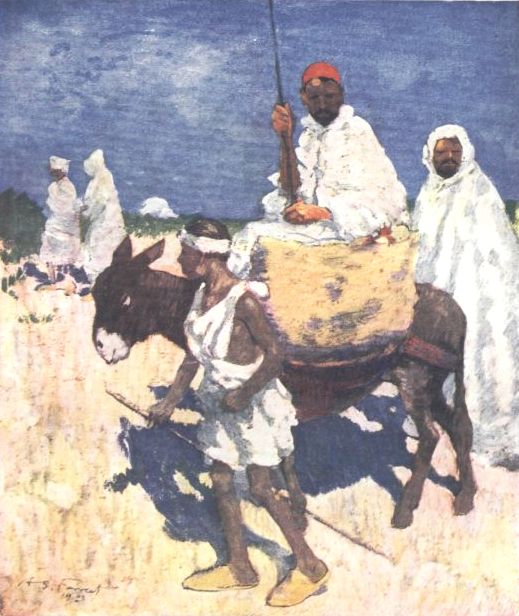
Straightway men and beasts made their way through the narrow cobbled lanes. Sneering camels, so bulked out by their burdens that a foot-passenger must shrink against the wall to avoid a bad bruising; well-fed horses, carrying some early-rising Moor of rank on the top of seven saddle-cloths; half-starved donkeys, all sores and bruises; one encountered every variety of Moorish traffic here, and the thoroughfare, that had been deserted a moment before, was soon thronged. In addition to the Moors and Susi traders, there were many slaves, black as coal, brought in times past from the Soudan. From garden and orchard beyond the city the fruit and flowers and vegetables were being carried into their respective markets, and as they passed the air grew suddenly fragrant with a scent that was almost intoxicating. The garbage that lay strewn over the cobbles had no more power to offend, and the fresh scents added in some queer fashion of their own to the unreality of the whole scene.
To avoid the crush we turned to another quarter of the city, noting that the gates of the bazaars were opened, and that only the chains were left across the entrance. But the tiny shops, mere overgrown packing-cases, were still locked up; the merchants, who are of higher rank than the dealers in food-stuffs, seldom appear before the day is aired, and their busiest hours are in the afternoon, when the auction is held. "Custom is from Allah," they say, and, strong in this belief, they hold that time is only valuable as leisure. And, God wot, they may well be wiser herein than we are.
A demented countryman, respected as a saint by reason of his madness, a thing of rags and tatters and woefully unkempt hair, a quite wild creature, more than six feet high, and gaunt as a lightning-smitten pine, came down the deserted bazaar of the brass-workers. He carried a long staff in one hand, a bright tin bowl in the other. The sight of a European heightened his usual frenzy—
A thought came streaming like a blazing ship
Upon a mighty wind.
I saw the sinews stand out on the bare arm that gripped the staff, and his bright eyes were soon fixed upon me. "You do not say words to him, sir," whispered Salam; "he do'n know what he do—he very holy man."
The madman spat on my shadow, and cursed profoundly, while his passion was mastering him. I noted with interest in that uncomfortable moment the clear signs of his epileptic tendencies, the twitching of the thumb that grasped the stick, the rigidity of the body, the curious working of certain facial muscles. I stood perfectly still, though my right hand involuntarily sought the pocket of my coat where my revolver lay, the use of which save in direst necessity had been a mad and wicked act; and then two peace-loving Moors, whose blue selhams of fine Manchester cloth proclaimed their wealth and station, came forward and drew the frenzied creature away, very gently and persuasively. He, poor wretch, did not know what was taking place, but moved helplessly to the door of the bazaar and then fell, his fit upon him. I hurried on. Moors are kindly, as well as respectful, to those afflicted of Allah.
We passed on our way to the Bab Dukala, the gate that opens out upon Elhara, the leper quarter. There we caught our morning view of the forest of date-palm that girdles the town. Moors say that in centuries long past Marrakesh was besieged by the men of Tafilalt, who brought dates for food, and cast the stones on the ground. The rain buried them, the Tensift nourished them, and to-day they crowd round Ibn Tachfin's ruinous city, 'their feet in water and their heads in fire.' 'Tis an agreeable legend.
Market men, half naked and very lean, were coming in from Tamsloht and Amsmiz, guiding their heavy-laden donkeys past the crumbling walls and the steep valley that separates Elhara from the town. Some scores of lepers had left their quarters, a few hiding terrible disfigurement under great straw hats, others quite careless of their deplorable disease. Beggars all, they were going on their daily journey to the shrine of Sidi bel Abbas, patron of the destitute, to sit there beneath the zowia's ample walls, hide their heads in their rags, and cry upon the passers to remember them for the sake of the saint who had their welfare so much at heart. And with the closing of the day they would be driven out of the city, and back into walled Elhara, to such of the mud huts as they called home. Long acquaintance with misery had made them careless of it. They shuffled along as though they were going to work, but from my shaded corner, where I could see without being seen, I noted no sign of converse between them, and every face that could be studied was stamped with the impress of unending misery.
The scene around us was exquisite. Far away one saw the snow-capped peaks of the Atlas; hawks and swallows sailed to and from Elhara's walls; doves were cooing in the orchards, bee-eaters flitted lightly amid the palms. I found myself wondering if the lepers ever thought to contrast their lives with their surroundings, and I trusted they did not. Some few, probably, had not been lepers, but criminals, who preferred the horrid liberty of Elhara to the chance of detection and the living death of the Hib Misbah. Other beggars were not really lepers, but suffered from one or other of the kindred diseases that waste Morocco. In Marrakesh the native doctors are not on any terms with skilled diagnosis, and once a man ventures into Elhara, he acquires a reputation for leprosy that serves his purpose. I remember inquiring of a Moorish doctor the treatment of a certain native's case. "Who shall arrest Allah's decree?" he began modestly. And he went on to say that the best way to treat an open wound was to put powdered sulphur upon it, and apply a light.[22] Horrible as this remedy seems, the worthy doctor believed in it, and had sent many a True Believer to—Paradise, I hope—by treating him on these lines. Meanwhile his profound confidence in himself, together with his knowledge and free use of the Koran, kept hostile criticism at bay.[23]
We turned back into the city, to see it in another aspect. The rapid rise of the sun had called the poorer workers to their daily tasks; buyers were congregating round the market stalls of the dealers in meat, bread, vegetables, and fruit. With perpetual grace to Allah for his gift of custom, the stall-keepers were parting with their wares at prices far below anything that rules even in the coast towns of the Sultan's country. The absence of my Lord Abd-el-Aziz and his court had tended to lower rates considerably. It was hard to realise that, while food cost so little, there were hundreds of men, women, and children within the city to whom one good meal a day was something almost unknown. Yet this was certainly the case.
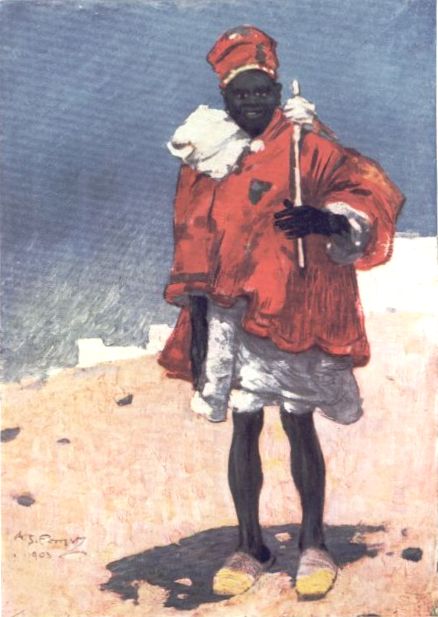
Towering above the other buyers were the trusted slaves of the wazeers in residence—tall negroes from the far South for the most part—hideous men, whose black faces were made the more black by contrast with their white robes. They moved with a certain sense of dignity and pride through the ranks of the hungry freemen round them; clearly they were well contented with their lot—a curious commentary upon the European notions of slavery—based, to be sure, upon European methods in regard to it. The whole formed a marvellous picture, and how the pink roses, the fresh, green mint and thyme, the orange flowers and other blossoms, sweetened the narrow ways, garbage-strewn under foot and roofed overhead with dried leaves of the palm!
[17] "Moghreb-al-Acksa."
[18] Street cleaners are paid out of the proceeds of a tax derived from the slaughter of cattle, and the tax is known to Moorish butchers by a term signifying "floos of the throat."
[19] I.e. The Tin House.
[20] Declaration of Faith.
[21] The false dawn.
[22] The Sultan Mulaz-Abd-el-Aziz was once treated for persistent headache by a Moorish practitioner. The wise man's medicine exploded suddenly, and His Majesty had a narrow escape. I do not know whether the practitioner was equally fortunate.
[23] The doctors and magicians of Morocco have always been famous throughout the East. Nearly all the medicine men of the Thousand Nights and a Night including the uncle of Aladdin, are from the Moghreb.
ROUND ABOUT MARRAKESH
CHAPTER VI
"Speaking of thee comforts me, and thinking of thee makes me glad."
—Râod el Kartas.
The charm of Marrakesh comes slowly to the traveller, but it stays with him always, and colours his impressions of such other cities as may attract his wandering footsteps. So soon as he has left the plains behind on his way to the coast, the town's defects are relegated to the background of the picture his memory paints. He forgets the dirty lanes that serve for roads, the heaps of refuse at every corner, the pariah curs that howled or snapped at his horse's heels when he rode abroad, the roughness and discomfort of the accommodation, the poverty and disease that everywhere went hand in hand around him.
But he remembers and always will remember the city in its picturesque aspects. How can he forget Moorish hospitality, so lavishly exercised in patios where the hands of architect and gardener meet—those delightful gatherings of friends whose surroundings are recalled when he sees, even in the world of the West—
And the full moon, and the white evening star.
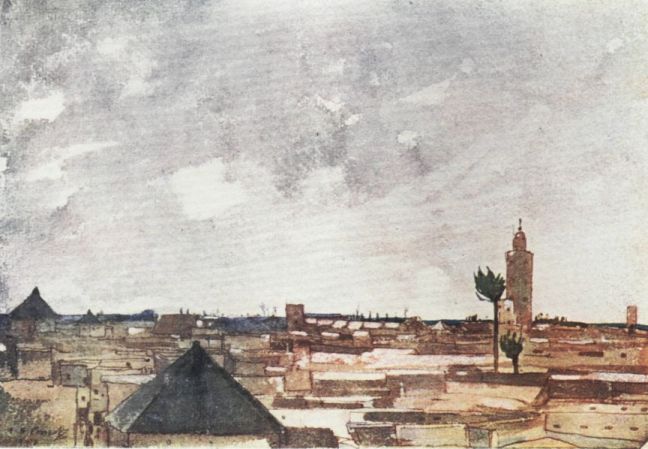
He will never forget the Kutubia tower flanking the mosque of the Library, with its three glittering balls that are solid gold, if you care to believe the Moors (and who should know better!), though the European authorities declare they are but gilded copper. He will hear, across all intervening sea and lands, the sonorous voices of the three blind mueddins who call True Believers to prayer from the adjacent minarets. By the side of the tower, that is a landmark almost from R'hamna's far corner to the Atlas Mountains, Yusuf ibn Tachfin, who built Marrakesh, enjoys his long, last sleep in a grave unnoticed and unhonoured by the crowds of men from strange, far-off lands, who pass it every day. Yet, if the conqueror of Fez and troubler of Spain could rise from nine centuries of rest, he would find but little change in the city he set on the red plain in the shadow of the mountains. The walls of his creation remain: even the broken bridge over the river dates, men say, from his time, and certainly the faith and works of the people have not altered greatly. Caravans still fetch and carry from Fez in the north to Timbuctoo and the banks of the Niger, or reach the Bab-er-rubb with gold and ivory and slaves from the eastern oases, that France has almost sealed up. The saints' houses are there still, though the old have yielded to the new. Storks are privileged, as from earliest times, to build on the flat roofs of the city houses, and, therefore, are still besought by amorous natives to carry love's greeting to the women who take their airing on the house-tops in the afternoon. Berber from the highlands; black man from the Draa; wiry, lean, enduring trader from Tarudant and other cities of the Sus; patient frugal Saharowi from the sea of sand,—no one of them has altered greatly since the days of the renowned Yusuf. And who but he among the men who built great cities in days before Saxon and Norman had met at Senlac, could look to find his work so little scarred by time, or disguised by change? Twelve miles of rampart surround the city still, if we include the walls that guard the Sultan's maze garden, and seven of the many gates Ibn Tachfin knew are swung open to the dawn of each day now.
After the Library mosque, with its commanding tower and modest yet memorable tomb, the traveller remembers the Sultan's palace, white-walled, green-tiled, vast, imposing; and the lesser mosque of Sidi bel Abbas, to whom the beggars pray, for it is said of him that he knew God. The city's hospital stands beside this good man's grave. And here one pays tribute also to great Mulai Abd el Kader Ijjilalli, yet another saint whose name is very piously invoked among the poor. The mosque by the Dukala gate is worthy of note, and earns the salutation of all who come by way of R'hamna to Marrakesh. The Kaisariyah lingers in the memory, and on hot days in the plains, when shade is far to seek, one recalls a fine fountain with the legend "drink and admire," where the water-carriers fill their goat-skins and all beggars congregate during the hours of fire.
The Mellah, in which the town Jews live, is reached by way of the Olive Garden. It is the dirtiest part of Marrakesh, and, all things considered, the least interesting. The lanes that run between its high walls are full of indescribable filth; comparison with them makes the streets of Madinah and Kasbah almost clean. One result of the dirt is seen in the prevalence of a very virulent ophthalmia, from which three out of four of the Mellah's inhabitants seem to suffer, slightly or seriously. Few adults appear to take exercise, unless they are called abroad to trade, and when business is in a bad way the misery is very real indeed. A skilled workman is pleased to earn the native equivalent of fourteenpence for a day's labour, beginning at sunrise, and on this miserable pittance he can support a wife and family. Low wages and poor living, added to centuries of oppression, have made the Morocco Jew of the towns a pitiable creature; but on the hills, particularly among the Atlas villages, the People of the Book are healthy, athletic, and resourceful, able to use hands as well as head, and the trusted intermediary between Berber hillman and town Moor.


/https%3A%2F%2Fassets.over-blog.com%2Ft%2Fcedistic%2Fcamera.png)
/http%3A%2F%2Fdafina.net%2Fgazette%2Fsites%2Fdefault%2Ffiles%2Fimagecache%2F400xY%2Fachoura.jpg)
/http%3A%2F%2Fwww.telexpresse.com%2Fimagesnews%2F1351245014.jpg)
/http%3A%2F%2Fwww.aufaitmaroc.com%2Fpictures%2F0089%2F1057%2Fsimon_levy_07122011160839_medium.jpg%3F1323281718)
