

/fdata%2F2453167%2Favatar-blog-1073688003-tmpphpuHSn6z.jpeg)
LIVRE:The Project Gutenberg EBook of Morocco, by S.L. Bensusan
ON THE MOORISH ROAD
CHAPTER III
Fraught with the thoughts of rustling shade, and welling spring, and rushing rain;
'Tis their's to pass with joy and hope, whose souls shall ever thrill and fill
Dreams of the Birthplace and the Tomb,—visions of Allah's Holy Hill.
We travel slowly, for the Maalem "father" of the pack-mules—guide, philosopher, and trusted companion—says that haste kills strong men, and often repeats a Moorish proverb which tells us that walking is better than running, and that of all things sitting still is best. If Salam and I, reaching a piece of level sward by the side of some orchard or arable land when the heat of the day has passed, venture to indulge in a brisk canter, the Maalem's face grows black as his eyes.
"Have a care," he said to me one evening, "for this place is peopled by djinoon, and if they are disturbed they will at least kill the horses and mules, and leave us to every robber among the hills." Doubtless the Maalem prophesied worse things than this, but I have no Arabic worth mention, and Salam, who acts as interpreter, possesses a very fair amount of tact. I own to a vulgar curiosity that urges me to see a djin if I can, so, after this warning, Salam and I go cantering every late afternoon when the Enemy, as some Moors call the sun, is moving down towards the west, and the air gets its first faint touch of evening cool. Fortunately or unfortunately, the evil spirits never appear however, unless unnoticed by me in the harmless forms of storks, stock-doves, or sparrow-hawks.
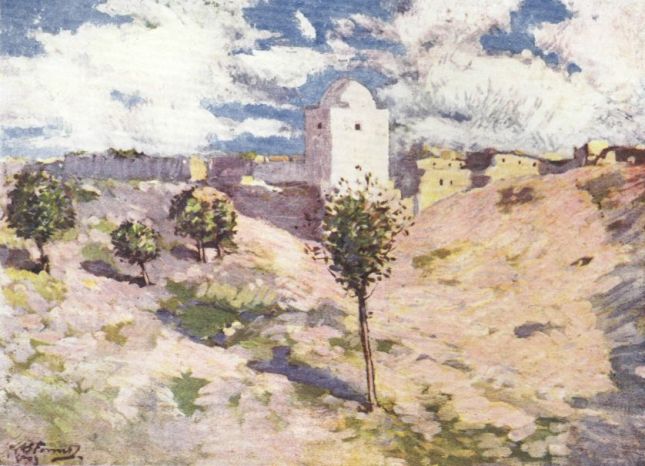
In this fertile province of the Dukala, in the little-known kingdom of the victorious Sultan, Mulai Abd-el-Aziz, there are delightful stretches of level country, and the husbandman's simplest toil suffices to bring about an abundant harvest. Unhappily a great part of the province is not in permanent cultivation at all. For miles and miles, often as far as the eye can see, the land lies fallow, never a farmhouse or village to be seen, nothing save some zowia or saint's tomb, with white dome rising within four white walls to stare undaunted at the fierce African sun, while the saint's descendants in the shelter of the house live by begging from pious visitors. Away from the fertility that marks the neighbourhood of the douars, one finds a few spare bushes, suddra, retam, or colocynth, a few lizards darting here and there, and over all a supreme silence that may be felt, even as the darkness that troubled Egypt in days of old. The main track, not to be dignified by the name of road, is always to be discerned clearly enough, at least the Maalem is never in doubt when stray paths, leading from nowhere to the back of beyond, intersect it.
At long intervals we pass a n'zala, a square empty space surrounded by a zariba of thorn and prickly pear. The village, a few wattled huts with conical roofs, stands by its side. Every n'zala is a Government shelter for travellers; you may pitch your tent within the four walls, and even if you remain outside and hire guards the owners of the huts are responsible for your safety, with their worldly goods, perhaps with their lives. I have tried the interior of the Moorish n'zalas, where all too frequently you must lie on unimagined filth, often almost within reach of camel-drivers and muleteers, who are so godly that they have no time to be clean, and I have concluded that the drawbacks outweigh the advantages. Now I pitch my tent on some cleaner spot, and pay guards from the village to stretch their blankets under its lee and go to sleep. If there are thieves abroad the zariba will not keep them out, and if there are no thieves a tired traveller may forget his fatigue.
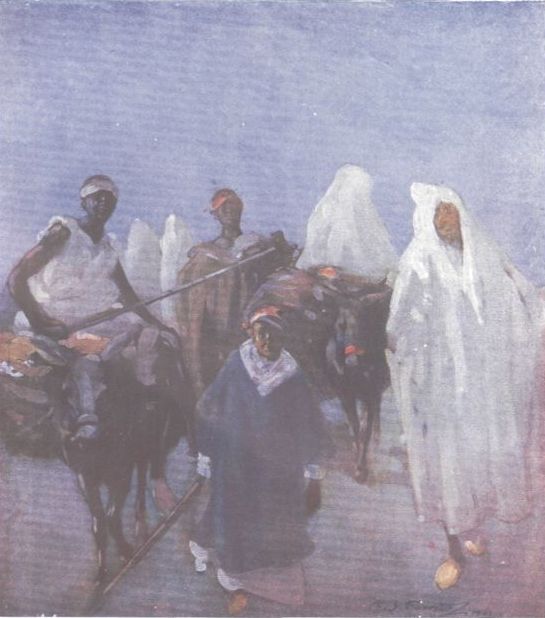
On the road we meet few wayfarers, and those we encounter are full of suspicion. Now and again we pass some country kaid or khalifa out on business. As many as a dozen well-armed slaves and retainers may follow him, and, as a rule, he rides a well-fed Barb with a fine crimson saddle and many saddle cloths. Over his white djellaba is a blue selham that came probably from Manchester; his stirrups are silver or plated. He travels unarmed and seldom uses spurs—a packing needle serves as an effective substitute. When he has spurs they are simply spear-heads—sharp prongs without rowels. The presence of Unbelievers in the country of the True Faith is clearly displeasing to him, but he is nearly always diplomat enough to return my laboured greeting, though doubtless he curses me heartily enough under his breath. His road lies from village to village, his duty to watch the progress of the harvest for his overlord. Even the locusts are kinder than the country kaids. But so soon as the kaid has amassed sufficient wealth, the governor of his province, or one of the high wazeers in the Sultan's capital, will despoil him and sell his place to the highest bidder, and in the fulness of time the Sultan will send for that wazeer or governor, and treat him in similar fashion. "Mektub," it is written, and who shall avoid destiny?[11]
When the way is long and the sun hot, pack and saddle animals come together, keeping a level pace of some five miles an hour, and Salam or the Maalem beguiles the tedium of the way with song or legend. The Maalem has a song that was taught him by one of his grandfather's slaves, in the far-off days when Mulai Mohammed reigned in Red Marrakesh. In this chant, with its weird monotonous refrain, the slaves sing of their journey from the lands of the South, the terrors of the way, the lack of food and water. It is a dismal affair enough, but the Maalem likes it, and Salam, riding under a huge Tetuan hat, carrying my shot gun, in case some fresh meat should come along, and keeping watchful eye on the mules, joins lustily in the refrain. Salam has few songs of his own, and does not care to sing them, lest his importance should suffer in the native eyes, but he possesses a stock of Arabian Nights' legends, and quotes them as though they were part of Al Koran.
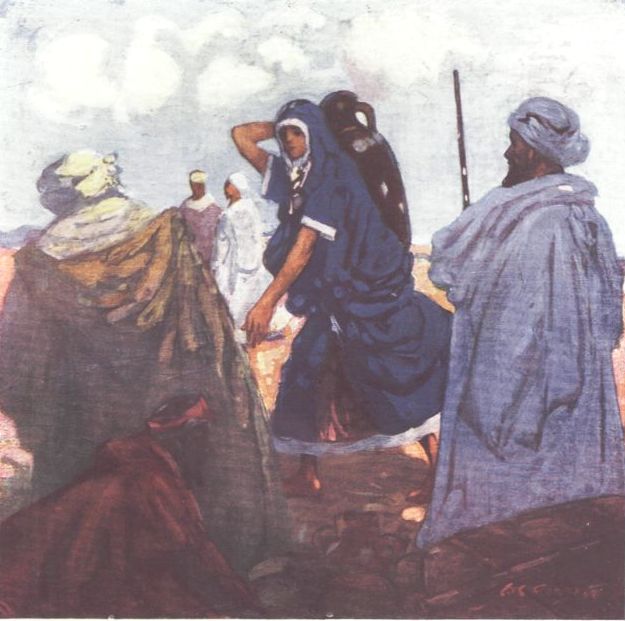
Now and again, in some of the waste and stony places beyond Dukala's boundaries, we come across a well, literally a well in the desert, with husbandmen gathered about it and drawing water in their goat-skin buckets, that are tied to long palmetto ropes made by the men of the neighbouring villages. The water is poured into flat, puddled troughs, and the thirsty flocks and herds drink in turn, before they march away to hunt for such scanty herbage as the land affords. The scene round these wells is wonderfully reminiscent of earliest Bible times, particularly so where the wandering Bedouins bring their flocks to water from the inhospitable territory of the Wad Nun and deserts below the Sus.
I note with pleasure the surprising dignity of the herdsmen, who make far less comment upon the appearance of the stranger in these wild places than we should make upon the appearance of a Moor or Berber in a London street.
The most unmistakable tribute to the value of the water is paid by the skeletons of camels, mules, sheep and goats that mark the road to the well. They tell the tale of animals beaten by the Enemy in their last stride. It is not easy for a European to realise the suffering these strange lands must see when the summer drought is upon the face of the earth. Perhaps they are lessened among the human sufferers by the very real fatalism that accepts evil as it accepts good, without grief and without gladness, but always with philosophic calm; at least we should call it philosophic in a European; superstitious fatalism, of course, in a Moor.
The earliest and latest hours of our daily journey are, I think, the best. When afternoon turns toward evening in the fertile lands, and the great heat begins to pass, countless larks resume their song, while from every orchard one hears the subdued murmur of doves or the mellow notes of the nightingale. Storks sweep in wide circles overhead or teach their awkward young the arts of flight, or wade solemnly in search of supper to some marsh where the bull-frogs betray their presence by croaking as loudly as they can. The decline of the sun is quite rapid—very often the afterglow lights us to our destination. It is part of the Maalem's duty to decide upon the place of our nightly sojourn, and so to regulate the time of starting, the pace, and the mid-day rest, that he may bring us to the village or n'zala in time to get the tent up before darkness has fallen. The little man is master of every turn in the road, and has only failed once—when he brought us to a large village, where the bulk of the inhabitants of outlying douars had attacked the Governor's house, with very little success, on the previous day, and were now about to be attacked in their turn by the Governor and his bodyguard. There had been much firing and more shouting, but nobody was badly hurt. Prudence demanded that the journey be resumed forthwith, and for three hours the Maalem kept his eyes upon the stars and cursed the disturbers of the land's peace. Then we reached the desired haven, and passed unscathed through the attacks of the native dogs that guarded its approaches.
The procedure when we approach a n'zala in the evening is highly interesting. Some aged headman, who has seen our little company approaching, stands by the edge of the road and declares we are welcome.[12] Salam or the Maalem responds and presents me, a traveller from the far country of the Ingliz, carrying letters to the great sheikhs of the South. The headman repeats his welcome and is closely questioned concerning the existing supplies of water, corn, milk, eggs, and poultry. These points being settled, Salam asks abouts guards. The strangers would sleep outside the n'zala: Can they have guards at a fair price? Three are promised for a payment of about sevenpence apiece, and then the headman precedes us and we turn from the main track to the place of shelter.
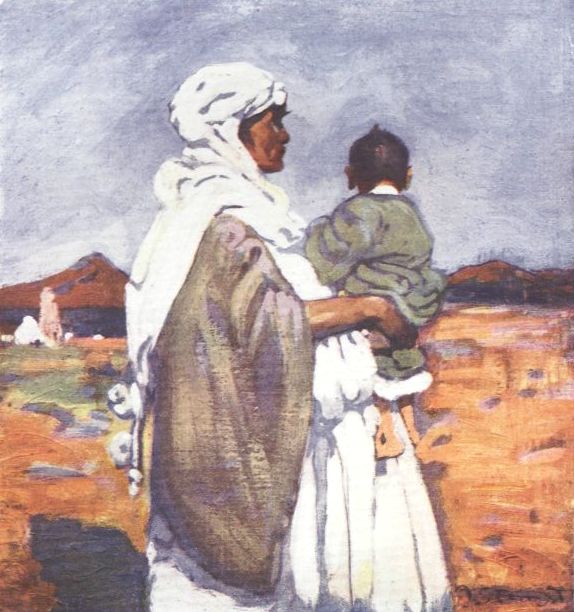
Instantly the village is astir. The dogs are driven off. Every wattled hut yields its quota of men, women, and children, spectral in their white djellabas and all eager to see the strangers and their equipment. The men collect in one group and talk seriously of the visit, well assured that it has some significance, probably unpleasant; the women, nervous by nature and training, do not venture far from their homes and remain veiled to the eyes. But the children—dark, picturesque, half-naked boys and girls—are nearly free from fear if not from doubt. The tattoo marks on their chins keep them safe from the evil eye; so they do not run much risk from chance encounter with a European. They approach in a constantly shifting group, no detail of the unpacking is lost to them, they are delighted with the tent and amazed at the number of articles required to furnish it, they refuse biscuits and sugar, though Salam assures them that both are good to eat, and indeed sugar is one of the few luxuries of their simple lives.
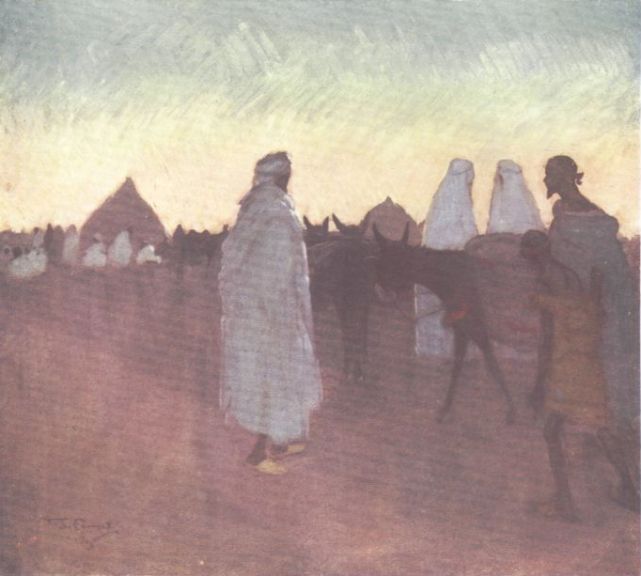
By the headman's direction our wants are supplied. The patriarch, with his long white beard and clear far-seeing eyes, receives the respect and obedience of all the village, settles all disputes, and is personally responsible to the kaid of the district for the order and safety of the n'zala. Three men come from the well, each bearing a big clay amphora of water that must be boiled before we drink it. One brings an ample measure of barley, costing about four shillings or a little more in English money, another bends under a great load of straw. Closely-veiled women carry small jars of milk and hand them to their lord, who brings them up to Salam and states the price demanded. Milk is dear throughout Morocco in the late spring and summer, for, herbage being scanty, cows are small and poor. Eggs, on the other hand, are cheap; we can buy a dozen for twopence or its equivalent in Spanish or Moorish money, and chickens cost about fivepence apiece. If Salam, M'Barak and the Maalem were travelling alone they would pay less, but a European is rarely seen, and his visit must be made memorable.
Provisions purchased, the tent up, mules and horses tethered together in full view of the tent, a great peace falls upon our little party. I am permitted to lie at full length on a horse rug and stare up at the dark, star-spangled sky; Salam has dug a little hole in the ground, made a charcoal fire, and begun to prepare soup and boil the water for coffee. The Maalem smokes kief in furtive manner, as though orthodox enough to be ashamed of the practice, while M'Barak prepares plates and dishes for the evening meal. Around, in a semicircle, some ten yards away, the men and boys of the village sit observing us solemnly. They have little to say, but their surprise and interest are expressed quite adequately by their keen unfailing regard. The afterglow passes and charcoal fires are lighted at the edge of most of the native huts, in preparation for the evening meal, for the young shepherds have come from the fields and the flocks are safely penned. In the gathering dusk the native women, passing through the smoke or by the flame of their fire, present a most weird picture, as it might be they were participating in a Witches' Sabbath. Darkness envelops all the surrounding country, hiding the road by which we came, sealing up the track we have to follow, striking a note of loneliness that is awesome without being unpleasant. With what we call civilisation hundreds of miles away, in a country where law and order are to be regarded more as names than facts, one has a great joy in mere living, intensified doubtless by long hours spent in the saddle, by occasional hard work and curtailed rest, and by the daily sight of the rising sun.
The evening meal is a simple affair of soup, a chicken, and some coffee to follow, and when it is over I make my way to the kitchen tent, where the men have supped, and send M'Barak with an invitation to the headman and his sons. The blessed one makes his way to the headman's hut, while Salam clears up the debris of the meal, and the Maalem, conscious that no more work will be expected of him, devotes his leisure to the combustion of hemp, openly and unashamed. With many compliments the headman arrives, and I stand up to greet and bid him welcome—an effort that makes heavy call upon my scanty store of Arabic. The visitors remove their slippers and sit at ease, while Salam makes a savoury mess of green tea, heavily sweetened and flavoured with mint. My visitors are too simply pious to smoke, and regard the Maalem with displeasure and surprise, but he is quite beyond the reach of their reproaches now. His eyes are staring glassily, his lips have a curious ashen colour, his hands are twitching—the hemp god has him by the throat. The village men turn their backs upon this degraded Believer, and return thanks to Allah the One for sending an infidel who gives them tea. Broadly speaking, it is only coast Moors, who have suffered what is to them the contamination of European influences, that smoke in Morocco.
Like the Walrus and the Carpenter, we talk of many things, Salam acting as interpreter. The interests of my guests are simple: good harvests, abundant rain, and open roads are all they desire. They have never seen the sea or even a big Moorish town, but they have heard of these things from travellers and traders who have passed their nights in the n'zala in times recent or remote, and sometimes they appeal to me to say if these tales are true. Are there great waters of which no man may drink—waters that are never at rest? Do houses with devils (? steam engines) in them go to and fro upon the face of these waters? Are there great cities so big that a man cannot walk from end to end in half a day? I testify to the truth of these things, and the headman praises Allah, who has done what seemed good to him in lands both near and far. It is, I fear, the headman's polite way of saying that Saul is among the prophets. My revolver, carefully unloaded, is passed from hand to hand, its uses and capacities are known even to these wild people, and the weapon creates more interest than the tent and all its varied equipment. Naturally enough, it turns the talk to war and slaughter, and I learn that the local kaid has an endless appetite for thieves and other children of shameless women, that guns are fired very often within his jurisdiction, and baskets full of heads have been collected after a purely local fight. All this is said with a quiet dignity, as though to remind me that I have fallen among people of some distinction, and the effect is only spoilt by the recollection that nearly every headman has the same tale to tell. Sultans, pretenders, wazeers, and high court functionaries are passed in critical review, their faults and failings noted. I cannot avoid the conclusion that the popular respect is for the strong hand—that civilised government would take long to clear itself of the imputation of cowardice. The local kaid is always a tyrant, but he is above all things a man, keen-witted, adventurous, prompt to strike, and determined to bleed his subjects white. So the men of the village, while suffering so keenly from his arbitrary methods, look with fear and wonder at their master, respect him secretly, and hope the day will come when by Allah's grace they too will be allowed to have mastery over their fellows and to punish others as they have been punished. Strength is the first and greatest of all virtues, so far as they can see, and cunning and ferocity are necessary gifts in a land where every man's hand is against his neighbour.
The last cup of green tea has been taken, the charcoal, no longer refreshed by the bellows, has ceased to glow, around us the native fires are out. The hour of repose is upon the night, and the great athletic villagers rise, resume their slippers, and pass with civil salutation to their homes. Beyond the tent our guards are sleeping soundly in their blankets; the surrounding silence is overwhelming. The grave itself could hardly be more still. Even the hobbled animals are at rest, and we enter into the enveloping silence for five or six dreamless hours.
The horses stir and wake me; I open the tent and call the men. Our guards rouse themselves and retire to their huts. The Maalem, no worse, to outward seeming, for the night's debauch, lights the charcoal. It is about half-past three, the darkness has past but the sun has not risen, the land seems plunged in heavy sleep, the air is damp and chill. Few pleasures attach to this early rising, but it is necessary to be on the road before six o'clock in order to make good progress before the vertical rays of the sun bid us pause and seek what shelter we can find. Two hours is not a long time in which to strike tents, prepare breakfast,—a solid affair of porridge, omelette, coffee, marmalade and biscuits,—pack everything, and load the mules. We must work with a will, or the multi-coloured pageant in the eastern sky will have passed before we are on the road again.
Early as it is we are not astir much before the village. Almost as soon as I am dressed the shepherd boys and girls are abroad, playing on their reed flutes as they drive the flocks to pasture from the pens to which they were brought at sundown. They go far afield for food if not for water, but evening must see their animals safely secured once more, for if left out overnight the nearest predatory tribesmen would carry them off. There is no security outside the village, and no village is safe from attack when there is unrest in the province. A cattle raid is a favourite form of amusement among the warlike tribes of the Moorish country, being profitable, exciting, and calculated to provoke a small fight.
A group of interested observers assembles once more, reinforced by the smallest children, who were too frightened to venture out of doors last night. Nothing disturbs the little company before we leave the camp. The headman, grave and dignified as ever, receives payment for corn, straw, chickens, milk, eggs, water, and guards, a matter of about ten shillings in English money, and a very large sum indeed for such a tiny village to receive. The last burden is fastened on the patient mules, girths and straps and belts are examined, and we pass down the incline to the main road and turn the horses' heads to the Atlas Mountains.
[11] "There happeneth no misfortune on the earth or to yourselves, but it is written in the Book before we created it: verily that is easy to Allah."—Al Koran; Sura, "The Tree."
[12] This courtesy is truly Eastern, and has many variants. I remember meeting two aged rabbis who were seated on stones by the roadside half a mile from the city of Tiberias on the Sea of Galilee. They rose as I approached, and said in Hebrew, "Blessed be he who cometh."
TO THE GATES OF MARRAKESH
CHAPTER IV
The world is sweet in sound and sight,
Glad thoughts and birds take flower and flight,
The heather kindles toward the light,
The whin is frankincense and flame.
If you would savour the true sense of Morocco, and enjoy glimpses of a life that belongs properly to the era of Genesis, journey through Dukala, Shiadma, or Haha in April. Rise early, fare simply, and travel far enough to appreciate whatever offers for a camping-ground, though it be no more than the grudging shadow of a wall at mid-day, or a n'zala not overclean, when from north, south, east, and west the shepherd boys and girls are herding their flocks along the homeward way. You will find the natives kind and leisured enough to take interest in your progress, and, their confidence gained, you shall gather, if you will, some knowledge of the curious, alluring point of view that belongs to fatalists. I have been struck by the dignity, the patience, and the endurance of the Moor, by whom I mean here the Arab who lives in Morocco, and not the aboriginal Berber, or the man with black blood preponderating in his veins. To the Moor all is for the best. He knows that Allah has bound the fate of each man about his neck, so he moves fearlessly and with dignity to his appointed end, conscious that his God has allotted the palace or the prison for his portion, and that fellow-men can no more than fulfil the divine decree. Here lies the secret of the bravery that, when disciplined, may yet shake the foundations of Western civilisation. How many men pass me on the road bound on missions of life or death, yet serene and placid as the mediæval saints who stand in their niches in some cathedral at home. Let me recall a few fellow-wayfarers and pass along the roadless way in their company once again.
First and foremost stands out a khalifa, lieutenant of a great country kaid, met midmost Dukala, in a place of level barley fields new cut with the media luna. Brilliant poppies and irises stained the meadows on all sides, and orchards whose cactus hedges, planted for defence, were now aflame with blood-red flowers, became a girdle of beauty as well as strength. The khalifa rode a swiftly-ambling mule, a beast of price, his yellow slippers were ostentatiously new, and his ample girth proclaimed the wealthy man in a land where all the poor are thin. "Peace," was his salutation to M'Barak, who led the way, and when he reached us he again invoked the Peace of Allah upon Our Lord Mohammed and the Faithful of the Prophet's House, thereby and with malice aforethought excluding the infidel. Like others of his class who passed us he was but ill-pleased to see the stranger in the land; unlike the rest he did not conceal his convictions. Behind him came three black slaves, sleek, armed, proud in the pride of their lord, and with this simple retinue the khalifa was on his way to tithe the newly-harvested produce of the farmers who lived in that district. Dangerous work, I thought, to venture thus within the circle of the native douars and claim the lion's share of the hard-won produce of the husbandmen. He and his little company would be outnumbered in the proportion of thirty or forty to one, they had no military following, and yet went boldly forth to rob on the kaid's behalf. I remembered how, beyond Tangier, the men of the hills round Anjera had risen against an unpopular khalifa, had tortured him in atrocious fashion, and left him blind and hideously maimed, to be a warning to all tyrants. Doubtless our prosperous fellow-traveller knew all about it, doubtless he realised that the Sultan's authority was only nominal, but he knew that his immediate master, the Basha, still held his people in an iron grip while, above and beyond all else, he knew by the living faith that directed his every step in life, that his own fate, whether good or evil, was already assigned to him. I heard the faint echo of the greeting offered by the dogs of the great douar into which he passed, and felt well assured that the protests of the village folk, if they ventured to protest, would move him no more than the barking of those pariahs. The hawks we saw poised in the blue above our heads when small birds sang at sunsetting, were not more cheerfully devoid of sentiment than our khalifa, though it may be they had more excuse than he.
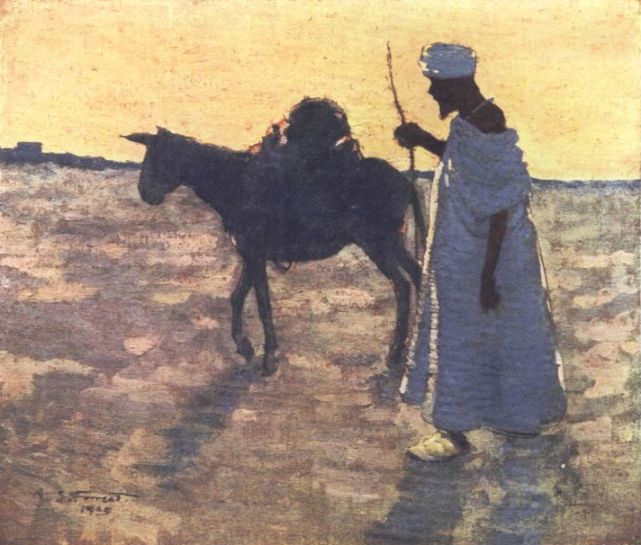
On another afternoon we sat at lunch in the grateful sombre shade of a fig-tree. Beyond the little stone dyke that cut the meadow from the arable land a negro ploughed with an ox and an ass, in flat defiance of Biblical injunction. The beasts were weary or lazy, or both, and the slave cursed them with an energy that was wonderful for the time of day. Even the birds had ceased to sing, the cicadas were silent in the tree tops, and when one of the mules rolled on the ground and scattered its pack upon all sides, the Maalem was too exhausted to do more than call it the "son of a Christian and a Jew."
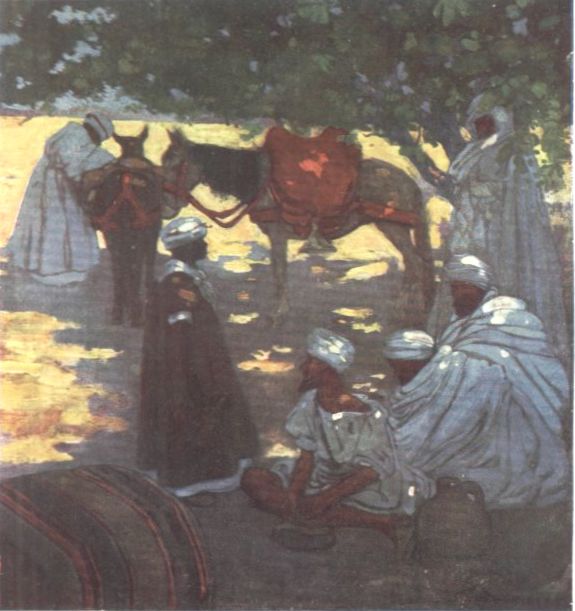
Down the track we had followed came a fair man, of slight build, riding a good mule. He dismounted by the tree to adjust his saddle, tighten a stirrup thong, and say a brief prayer. Then, indifferent to the heat, he hurried on, and Salam, who had held short converse with him, announced that he was an emissary of Bu Hamara the Pretender, speeding southward to preach the rising to the Atlas tribes. He carried his life in his hands through the indifferently loyal southern country, but the burden was not heavy enough to trouble him. Bu Hamara, the man no bullets could injure, the divinely directed one, who could call the dead from their pavilion in Paradise to encourage the living, had bade him go rouse the sleeping southerners, and so he went, riding fearlessly into the strong glare that wrapt and hid him. His work was for faith or for love: it was not for gain. If he succeeded he would not be rewarded, if he failed he would be forgotten.
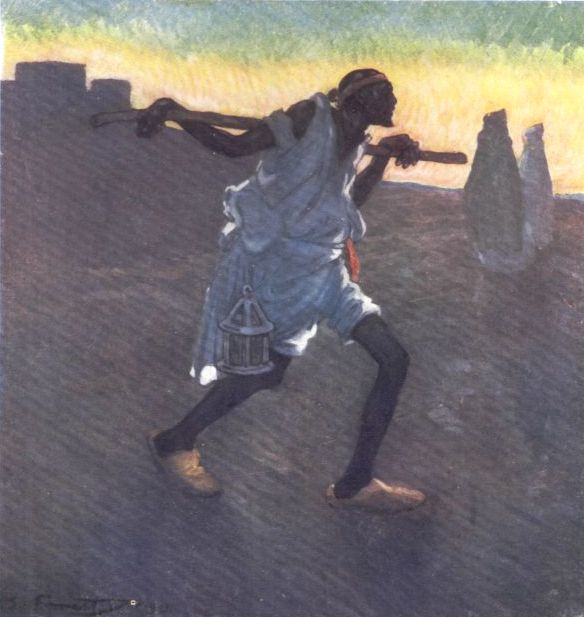
Very often, at morning, noon, and sunset, we would meet the r'kass or native letter-carrier, a wiry man from the Sus country, more often than not, with naked legs and arms. In his hand he would carry the long pole that served as an aid to his tired limbs when he passed it behind his shoulders, and at other times helped him to ford rivers or defend himself against thieves. An eager, hurrying fellow was the r'kass, with rarely enough breath to respond to a salutation as he passed along, his letters tied in a parcel on his back, a lamp at his girdle to guide him through the night, and in his wallet a little bread or parched flour, a tiny pipe, and some kief. Only if travelling in our direction would he talk, repaying himself for the expenditure of breath by holding the stirrup of mule or horse. Resting for three to five hours in the twenty-four, sustaining himself more with kief than with bread, hardened to a point of endurance we cannot realise, the r'kass is to be met with on every Moorish road that leads to a big city—a solitary, brave, industrious man, who runs many risks for little pay. His letters delivered, he goes to the nearest house of public service, there to sleep, to eat sparingly and smoke incessantly, until he is summoned to the road again. No matter if the tribes are out on the warpath, so that the caravans and merchants may not pass,—no matter if the powder "speaks" from every hill,—the r'kass slips through with his precious charge, passing lightly as a cloud over a summer meadow, often within a few yards of angry tribesmen who would shoot him at sight for the mere pleasure of killing. If the luck is against him he must pay the heaviest penalty, but this seldom occurs unless the whole country-side is aflame. At other times, when there is peace in the land, and the wet season has made the unbridged rivers impassable, whole companies of travellers camp on either side of some river—a silver thread in the dry season, a rushing torrent now. But the r'kass knows every ford, and, his long pole aiding him, manages to reach his destination. It is his business to defy Nature if necessary, just as he defies man in the pursuit of his task. He is a living proof of the capacity and dogged endurance still surviving in a race Europeans affect to despise.
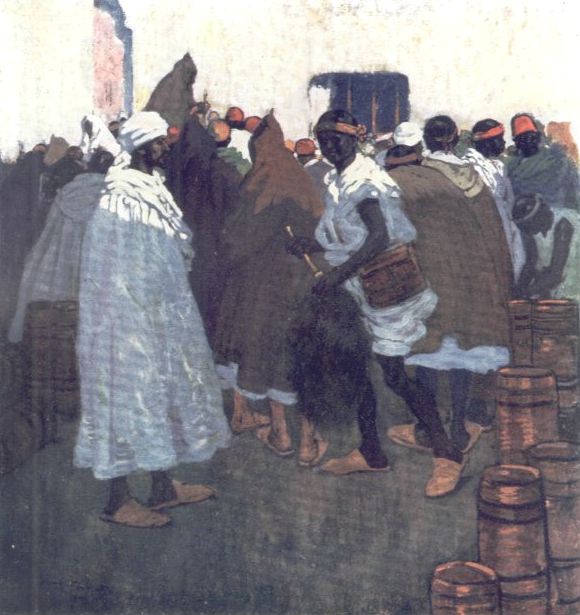
We met slaves-dealers too from time to time, carrying women and children on mules, while the men slaves walked along at a good pace. And the dealers by no means wore the villainous aspect that conventional observers look to see, but were plainly men bent upon business, travelling to make money. They regarded the slaves as merchandise, to be kept in tolerably fair condition for the sake of good sales, and unless Ruskin was right when he said that all who are not actively kind are cruel, there seemed small ground on which to condemn them. To be sure, they were taking slaves from market to market, and not bringing Soudanese captives from the extreme South, so we saw no trace of the trouble that comes of forced travel in the desert, but even that is equally shared by dealers and slave alike.
The villages of Morocco are no more than collections of conical huts built of mud and wattle and palmetto, or goat and camel skins. These huts are set in a circle all opening to the centre, where the live-stock and agricultural implements are kept at night. The furniture of a tent is simple enough. Handloom and handmill, earthenware jars, clay lamps, a mattress, and perhaps a tea-kettle fulfil all requirements.
A dazzling, white-domed saint's shrine within four square walls lights the landscape here and there, and gives to some douar such glory as a holy man can yield when he has been dead so long that none can tell the special direction his holiness took. The zowia serves several useful purposes. The storks love to build upon it, and perhaps the influence of its rightful owner has something to do with the good character of the interesting young birds that we see plashing about in the marshes, and trying to catch fish or frogs with something of their parents' skill. Then, again, the zowia shelters the descendants of the holy man, who prey upon passers in the name of Allah and of the departed.
Beyond one of the villages graced with the shrine of a forgotten saint, I chanced upon a poor Moorish woman washing clothes at the edge of a pool. She used a native grass-seed in place of soap, and made the linen very white with it. On a great stone by the water's edge sat a very old and very black slave, and I tried with Salam's aid to chat with him. But he had no more than one sentence. "I have seen many Sultans," he cried feebly, and to every question he responded with these same words. Two tiny village boys stood hand in hand before him and repeated his words, wondering. It was a curious picture and set in striking colour, for the fields all round us were full of rioting irises, poppies, and convolvuli; the sun that gilded them was blazing down upon the old fellow's unprotected head. Gnats were assailing him in legions, singing their flattering song as they sought to draw his blood.[13] Before us on a hill two meadows away stood the douar, its conical huts thatched with black straw and striped palmetto, its zowia with minaret points at each corner of the protecting walls, and a stork on one leg in the foreground. It cost me some effort to tear myself away from the place, and as I remounted and prepared to ride off the veteran cried once more, "I have seen many Sultans." Then the stork left his perch on the zowia's walls, and settled by the marsh, clapping his mandibles as though to confirm the old man's statement, and the little boys took up the cry, not knowing what they said. He had seen many Sultans. The Praise to Allah, so had not I.
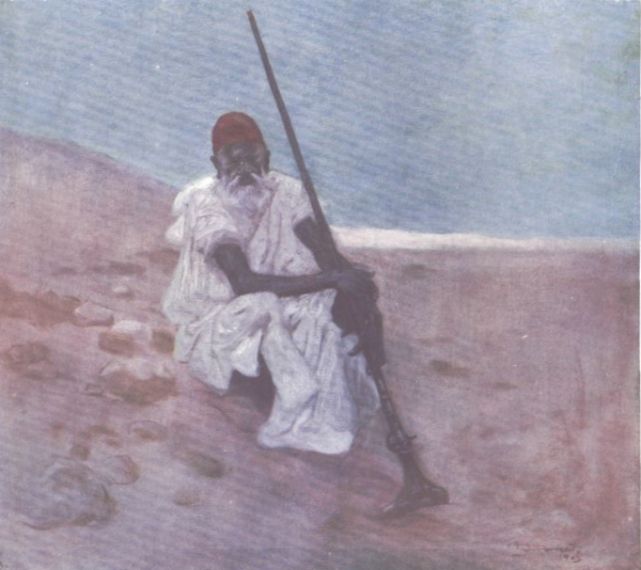
By another douar, this time on the outskirts of the R'hamna country, we paused for a mid-day rest, and entered the village in search of milk and eggs. All the men save one were at work on the land, and he, the guardian of the village, an old fellow and feeble, stood on a sandy mound within the zariba. He carried a very antiquated flint-lock, that may have been own brother to Kaid M'Barak's trusted weapon. I am sure he could not have had the strength to fire, even had he enjoyed the knowledge and possessed the material to load it. It was his business to mount guard over the village treasure. The mound he stood upon was at once the mat'mora that hid the corn store, and the bank that sheltered the silver dollars for whose protection every man of the village would have risked his life cheerfully. The veteran took no notice of our arrival: had we been thieves he could have offered no resistance. He remained silent and stationary, unconscious that the years in which he might have fulfilled his trust had gone for ever. All along the way the boundaries of arable land were marked by little piles of stones and I looked anxiously for some sign of the curious festival that greets the coming of the new corn, a ceremony in which a figure is made for worship by day and sacrifice by night; we were just too late for it. For the origin of this sacrifice the inquirer must go back to the time of nature worship. It was an old practice, of course, in the heyday of Grecian civilisation, and might have been seen in England, I believe, little more than twenty years ago.
Claims for protection are made very frequently upon the road. There are few of the dramatic moments in which a man rushes up, seizes your stirrup and puts himself "beneath the hem of your garment," but there are numerous claims for protection of another sort. In Morocco all the Powers that signed the Treaty of Madrid are empowered to grant the privilege. France has protected subjects by the thousand. They pay no taxes, they are not to be punished by the native authorities until their Vice-Consul has been cited to appear in their defence, and, in short, they are put above the law of their own country and enabled to amass considerable wealth. The fact that the foreigner who protects them is often a knave and a thief is a draw-back, but the popularity of protection is immense, for the protector may possibly not combine cunning with his greed, while the native Basha or his khalifa quite invariably does. British subjects may not give protection,—happily the British ideals of justice and fair-play have forbidden the much-abused practice,—and the most the Englishman can do is to enter into a trading partnership with a Moor and secure for him a certificate of limited protection called "mukhalat," from the name of the person who holds it. Great Britain has never abused the Protection system, and there are fewer protected Moors in the service or partnership of Britons throughout all Morocco than France has in any single town of importance.
If I had held the power and the will to give protection, I might have been in Morocco to-day, master of a house and a household, drawing half the produce of many fields and half the price of flocks of sheep and herds of goats. Few mornings passed without bringing some persecuted farmer to the camp, generally in the heat of the day, when we rested on his land. He would be a tall, vigorous man, burnt brown by the sun, and he would point to his fields and flocks, "I have so many sheep and goats, so many oxen for the plough, so many mules and horses, so much grain unharvested, so much in store. Give me protection, that I may live without fear of my kaid, and half of all I own shall be yours." Then I had to explain through Salam that I had no power to help him, that my Government would do no more than protect me. It was hard for the applicants to learn that they must go unaided. The harvest was newly gathered, it had survived rain and blight and locusts, and now they had to wait the arrival of their kaid or his khalifa, who would seize all they could not conceal,—hawk, locust, and blight in one.
At the village called after its patron saint, Sidi B'noor, a little deputation of tribesmen brought grievances for an airing. We sat in the scanty shade of the zowia wall. M'Barak, wise man, remained by the side of a little pool born of the winter rains; he had tethered his horse and was sleeping patiently in the shadow cast by this long-suffering animal. The headman, who had seen my sporting guns, introduced himself by sending a polite message to beg that none of the birds that fluttered or brooded by the shrine might be shot, for that they were all sacred. Needless perhaps to say that the idea of shooting at noonday in Southern Morocco was far enough from my thoughts, and I sent back an assurance that brought half a dozen of the village notables round us as soon as lunch was over. Strangely enough, they wanted protection—but it was sought on account of the Sultan's protected subjects. "The men who have protection between this place and Djedida," declared their spokesman, sorrowfully, "have no fear of Allah or His Prophet. They brawl in our markets and rob us of our goods. They insult our houses,[14] they are without shame, and because of their protection our lives have become very bitter."
"Have you been to your Basha?" I asked the headman.
"I went bearing a gift in my hand, O Highly Favoured," replied the headman, "and he answered me, 'Foolish farmer, shall I bring the Sultan to visit me by interfering with these rebels against Allah who have taken the protection from Nazarenes?' And then he cursed me and drove me forth from his presence. But if you will give protection to us also we will face these misbegotten ones, and there shall be none to come between us."


/https%3A%2F%2Fassets.over-blog.com%2Ft%2Fcedistic%2Fcamera.png)
/http%3A%2F%2Fdafina.net%2Fgazette%2Fsites%2Fdefault%2Ffiles%2Fimagecache%2F400xY%2Fachoura.jpg)
/http%3A%2F%2Fwww.telexpresse.com%2Fimagesnews%2F1351245014.jpg)
/http%3A%2F%2Fwww.aufaitmaroc.com%2Fpictures%2F0089%2F1057%2Fsimon_levy_07122011160839_medium.jpg%3F1323281718)
