

/fdata%2F2453167%2Favatar-blog-1073688003-tmpphpuHSn6z.jpeg)
LIVRE:The Project Gutenberg EBook of Morocco, by S.L. Bensusan
Yes, sir," he replied simply. "If I wait for bird to fly may be I miss him, an' waste cartridge."
This argument was, of course, unanswerable. He would follow birds slowly and deliberately, taking advantage of wind and cover, patient in pursuit and deadly in aim. Our points of view were different. I shot for sport, and he, and all Moors, for the bag. In this I felt he was my superior. But, barring storks, all creatures were game that came within Salam's range.
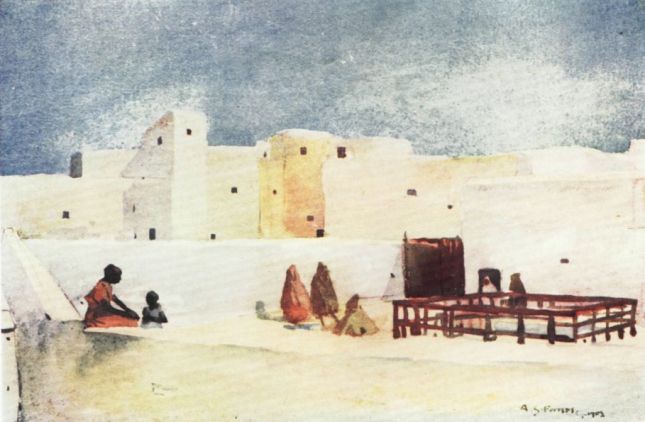
No Moor will harm a stork. Even Moorish children, whose taste for destruction and slaughter is as highly developed as any European's, will pick up a young stork that has fallen from its nest and return it to the mother bird if they can. Storks sit at peace among the women of the hareem who come for their afternoon airing to the flat roof-tops of Moorish houses. Moorish lovers in the streets below tell the story of their hopes and fears to the favoured bird, who, when he is chattering with his mandibles, is doing what he can to convey the message. Every True Believer knows that the stork was once a Sultan, or a Grand Wazeer at least, who, being vain and irreligious, laughed in the beards of the old men of his city on a sacred day when they came to pay their respects to him. By so doing he roused the wrath of Allah, who changed him suddenly to his present form. But in spite of misdeeds, the Moors love the stately bird, and there are hospitals for storks in Fez and Marrakesh, where men whose sanctity surpasses their ignorance are paid to minister to the wants of the sick or injured among them. Many a time Salam, in pursuit of birds, has passed within a few-yards of the father of the red legs or his children, but it has never occurred to him to do them harm. Strange fact, but undeniable, that in great cities of the East, where Muslims and Christians dwell, the storks will go to the quarter occupied by True Believers, and leave the other districts severely alone. I have been assured by Moors that the first of these birds having been a Muslim, the storks recognise the True Faith, and wish to testify to their preference for it. It is hard to persuade a Moor to catch a stork or take an egg from the nest, though in pursuit of other birds and beasts he is a stranger to compunction in any form.
One of the trackers gave me his horse, and Pepe Ratto led the way down the stream for a short distance and then into thick scrub that seemed to be part of wild life's natural sanctuary, so quiet it lay, so dense and undisturbed. After the first five minutes I was conscious of the forest in an aspect hitherto unknown to me; I was aware that only a man who knew the place intimately could venture to make a path through untrodden growths that were left in peace from year to year. It was no haphazard way, though bushes required careful watching, the double-thorned lotus being too common for comfort.
My companion's eye, trained to the observation of the woodlands in every aspect, noted the stories told by the bushes, the gravel, and the sand with a rapidity that was amazing. Twenty-five years of tireless hunting have given Pepe Ratto an instinct that seems to supplement the ordinary human gifts of sight and hearing. Our forefathers, who hunted for their living, must have had this gift so developed, and while lying dormant in Europeans, whose range of sports is compassed by the life of cities and limited game preserves, it persists among the men who devote the best years of their life to pitting their intelligence against that of the brute creation. The odds are of course very much in favour of the human being, but we may not realise readily the extreme cunning of hunted animals. The keen sportsman, who rode by my side pointing out the track of boar or porcupine, showing where animals had been feeding, and judging how recently they had passed by difference in the marks too faint for my eyes to see, confessed that he had spent months on the track of a single animal, baffled over and over again, but getting back to his quarry because he had with him the mark of the feet as copied when he tracked it for the first time.
"No boar has four feet absolutely identical with those of another boar," he said, "so when once you have the prints the animal must leave the forest altogether and get off to the Atlas, or you will find him in the end. He may double repeatedly on his own tracks, he may join a herd and travel with them for days into the thick scrub, where the dogs are badly torn in following him, but he can never get away, and the hunter following his tracks learns to realise in the frenzied changes and manoeuvres of the beast pursued, its consciousness of his pursuit." In these matters the trained and confirmed hunter's heart grows cold as the physiologist's, while his senses wax more and more acute, and near to the level of those of his prey.
That is but a small part of the hunter's lore. As his eyes and ears develop a power beyond the reach of dwellers of cities with stunted sight and spoiled hearing, he grows conscious of the great forest laws that rule the life of birds and beasts—laws yet unwritten in any language. He finds all living things pursuing their destiny by the light of customs that appeal as strongly to them as ours to us, and learns to know that the order and dignity of the lower forms of life are not less remarkable in their way than the phenomena associated with our own.
To me, the whirring of a covey of sand-grouse or partridges could express little more than the swift passage of birds to a place of security. To the man who grew almost as a part of the forest, the movement was something well defined, clearly initiated, and the first step in a sequence that he could trace without hesitation. One part of the forest might be the same as another to the casual rider, or might at best vary in its purely picturesque quality. To the long trained eye, on the other hand, it was a place that would or would not be the haunt of certain beasts or birds at certain hours of the day, by reason of its aspect with regard to the sun, its soil, cover, proximity to the river or other source of water supply, its freedom from certain winds and accessibility to others, its distance from any of the tracks that led to the country beyond the forest and were frequented at certain seasons of the year. The trained hunter reads all this as in a book, but the most of us can do no more than recognise the writing when it has been pointed out to us.
So it happened that my morning ride with the hardy hunter, whose achievements bulk next to those of the late Sir John Drummond Hay in the history of Moorish sport, had an interest that did not depend altogether upon the wild forest paths through which he led the way. He told me how at daybreak the pack of cross-bred hounds came from garden, copse, and woodland, racing to the steps of the Palm Tree House, and giving tongue lustily, as though they knew there was sport afoot. One or two grizzled huntsmen who had followed every track in the Argan Forest were waiting in the patio for his final instructions, and he told them of hoof prints that had revealed to his practised eye a "solitaire" boar of more than ordinary size. He had tracked it for more than three hours on the previous day, past the valley where our tents were set, and knew now where the lair was chosen.
"He has been lying under an argan tree, one standing well away from the rest at a point where the stream turns sharply, about a mile from the old kasbah in the wood, and he has moved now to make a new lair. I have made a note of his feet in my book; he had been wallowing less than twenty-four hours before when I found him. To-morrow, when we hunt the beast I hope to track to-day, the pack will follow in charge of the huntsmen. They will be taken through the wood all the way, for it is necessary to avoid villages and cattle pasture when you have more than a score of savage dogs that have not been fed since three o'clock on the previous afternoon. They are by no means averse from helping themselves to a sheep or a goat at such times."
We had ridden in single file through a part where the lotus, now a tree instead of a bush, snatched at us on either side, and the air was fragrant with broom, syringa, and lavender. Behind us the path closed and was hidden; before us it was too thick to see more than a few yards ahead. Here and there some bird would scold and slip away, with a flutter of feathers and a quiver of the leaves through which it fled; while ever present, though never in sight, the cuckoo followed us the whole day long. Suddenly and abruptly the path ended by the side of a stream where great oleanders spread their scarlet blossoms to the light, and kingfishers darted across the pools that had held tiny fish in waters left by the rainy season. When we pushed our horses to the brink the bushes on either hand showered down their blossoms as though to greet the first visitors to the rivulet's bank. Involuntarily we drew rein by the water's edge, acknowledging the splendour of the scene with a tribute of silence. If you have been in the Western Highlands of Scotland, and along the Levantine Riviera, and can imagine a combination of the most fascinating aspects of both districts, you have but to add to them the charm of silence and complete seclusion, the sense of virgin soil, and the joy of a perfect day in early summer, and then some faint picture of the scene may present itself. It remains with me always, and the mere mention of the Argan Forest brings it back.
Pepe Ratto soon recovered himself.
"Yes," he said, in reply to my unspoken thoughts, "one seldom sees country like this anywhere else. But the boar went this way."
So saying, the hunter uppermost again, he wheeled round, and we followed the stream quite slowly while he looked on either hand for signs of the large tusker. "We must find where he has settled," he continued. "Now the weather is getting so warm he will move to some place that is sandy and moist, within reach of the puddles he has chosen to wallow in. And he won't go far from this part, because the maize is not yet ripe."
"Do they grow maize in this province?" I asked.
"Yes," replied the hunter. "I give the farmers the seed and they plant it, for a boar is as fond of green maize as a fox is of chickens." He paused and showed me the marks of a herd that had come to the water within the past two days to drink and wallow. While I could see the marks of many feet, he could tell me all about the herd, the approximate numbers, the ages, and the direction they were taking. Several times we dismounted, and he examined the banks very carefully until, at the fourth or fifth attempt, tracks that were certainly larger than any we had seen revealed the long-sought tusker.
We went through the wood, the hunter bending over a trail lying too faint on the green carpet of the forest for me to follow. We moved over difficult ground, often under the blaze of the African sun, and, intent upon the pursuit, noted neither the heat nor the flight of time. For some two miles of the dense scrub, the boar had gone steadily enough until the ground opened into a clearing, where the soil was sandy and vegetation correspondingly light. Here at last the track moved in a circle.
"See," said the hunter, a suspicion of enthusiasm in his tone, "he has been circling; that means he is looking for a lair. Stay here, if you will, with the horses while I follow him home." And in a minute he was out of sight.
I waited patiently enough for what seemed a long time, trying to catch the undersong that thrilled through the forest, "the horns of elf-land faintly blowing," the hum such as bees at home make when late May sees the chestnut trees in flower. Here the song was a veritable psalm of life, in which every tree, bird, bush, and insect had its own part to play. It might have been a primeval forest; even the horses were grazing quietly, as though their spirits had succumbed to the solemn influences around us. The great god Pan himself could not have been far away, and I felt that he might have shown himself—that it was fitting indeed for him to appear in such a place and at such a season.
The hunter came back silently as he had gone.


/https%3A%2F%2Fassets.over-blog.com%2Ft%2Fcedistic%2Fcamera.png)
/http%3A%2F%2Fdafina.net%2Fgazette%2Fsites%2Fdefault%2Ffiles%2Fimagecache%2F400xY%2Fachoura.jpg)
/http%3A%2F%2Fwww.telexpresse.com%2Fimagesnews%2F1351245014.jpg)
/http%3A%2F%2Fwww.aufaitmaroc.com%2Fpictures%2F0089%2F1057%2Fsimon_levy_07122011160839_medium.jpg%3F1323281718)
