

/fdata%2F2453167%2Favatar-blog-1073688003-tmpphpuHSn6z.jpeg)
LIVRE:The Project Gutenberg EBook of Morocco, by S.L. Bensusan
A GLIMPSE OF THE ATLAS MOUNTAINS
"When the days of the Grand Wazeer were fulfilled," the Hadj continued gravely, "his enemies came into power. His brother the War Minister and his brother the Chamberlain died suddenly, and he followed them within the week. No wise man sought too particularly to know the cause of their death. Christians came to the Court Elevated by Allah, and said to my Lord Abd-el-Aziz, 'Be as the Sultans of the West.' And they brought him their abominations, the wheeled things that fall if left alone, but support a man who mounts them, as I suppose, in the name of Shaitan; the picture boxes that multiply images of True Believers and, being as the work of painters,[34] are wisely forbidden by the Far Seeing Book; carriages drawn by invisible djinoon, who scream and struggle in their fiery prison but must stay and work, small sprites that dance and sing.[35] The Christians knew that my Lord was but a young man, and so they brought these things, and Abd-el-Aziz gave them of the country's riches, and conversed with them familiarly, as though they had been of the house of a Grand Shareef. But in the far east of the Moghreb the French closed the oases of Tuat and Tidikelt without rebuke, and burnt Ksor and destroyed the Faithful with guns containing green devils,[36] and said, 'We do all this that we may venture abroad without fear of robbers.' Then my Lord sent the War Minister, the kaid Maheddi el Menebhi, to London, and he saw your Sultan face to face. And your Sultan's wazeers said to him, 'Tell the Lord of the Moghreb to rule as we rule, to gather his taxes peaceably and without force, to open his ports, to feed his prisoners, to follow the wisdom of the West. If he will do this, assuredly his kingdom shall never be moved.' Thereafter your Sultan's great men welcomed the kaid yet more kindly, and showed him all that Allah the One had given them in his mercy, their palaces, their workplaces, their devil ships that move without sails over the face of the waters, and their unveiled women who pass without shame before the faces of men. And though the kaid said nothing, he remembered all these things.
"When he returned, and by the aid of your own Bashador in Tanjah prevailed over the enemies who had set snares in his path while he fared abroad, he stood up before my Lord and told him all he had seen. Thereupon my Lord Abd-el-Aziz sought to change that which had gone before, to make a new land as quickly as the father of the red legs[37] builds a new nest, or the boar of the Atlas whom the hunter has disturbed finds a new lair. And the land grew confused. It was no more the Moghreb, but it assuredly was not as the lands of the West.
"In the beginning of the season of change the French were angry. 'All men shall pay an equal tax throughout my land,' said the King of the Age, and the Bashador of the French said, 'Our protected subjects shall not yield even a handful of green corn to the gatherer.' Now when the people saw that the tax-gatherers did not travel as they were wont to travel, armed and ready to kill, they hardened their hearts and said, 'We will pay no taxes at all, for these men cannot overcome us.' So the tribute was not yielded, and the French Bashador said to the Sultan, 'Thou seest that these people will not pay, but we out of our abundant wealth will give all the money that is needed. Only sign these writings that set forth our right to the money that is brought by Nazarenes to the seaports, and everything will be well.'
"So the Sultan set his seal upon all that was brought before him, and the French sent gold to his treasury and more French traders came to his Court, and my Lord gave them the money that had come to him from their country, for more of the foolish and wicked things they brought. Then he left Marrakesh and went to Fez; and the Rogui, Bu Hamara,[38] rose up and waged war against him."
The Hadj sighed deeply, and paused while fresh tea was brought by a coal-black woman slave, whose colour was accentuated by the scarlet rida upon her head, and the broad silver anklets about her feet. When she had retired and we were left alone once more, my host continued:—
"You know what happened after. My Lord Abd-el-Aziz made no headway against the Rogui, who is surely assisted by devils of the air and by the devils of France. North and south, east and west, the Moors flocked to him, for they said, 'The Sultan has become a Christian.' And to-day my Lord has no more money, and no strength to fight the Infidel, and the French come forward, and the land is troubled everywhere. But this is clearly the decree of Allah the All Wise, and if it is written that the days of the Filali Shareefs are numbered, even my Lord will not avoid his fate."
I said nothing, for I had seen the latter part of Morocco's history working itself out, and knew that the improved relations between Great Britain and France had their foundation in the change of front that kept our Foreign Office from doing for Morocco what it has done for other states divided against themselves, and what it had promised Morocco, without words, very clearly. Then, again, it was obvious to me, though I could not hope to explain it to my host, that the Moor, having served his time, had to go under before the wave of Western civilisation. Morocco has held out longer than any other kingdom of Africa, not by reason of its own strength, but because the rulers of Europe could not afford to see the Mediterranean balance of power seriously disturbed. Just as Mulai Ismail praised Allah publicly two centuries ago for giving him strength to drive out the Infidel, when the British voluntarily relinquished their hold upon Tangier, so successive Moorish Sultans have thought that they have held Morocco for the Moors by their own power. And yet, in very sober truth, Morocco has been no more than one of the pawns in the diplomatic game these many years past.
We who know and love the country, finding in its patriarchal simplicity so much that contrasts favourably with the hopeless vulgarity of our own civilisation, must recognise in justice the great gulf lying between a country's aspect in the eyes of the traveller and in the mind of the politician.
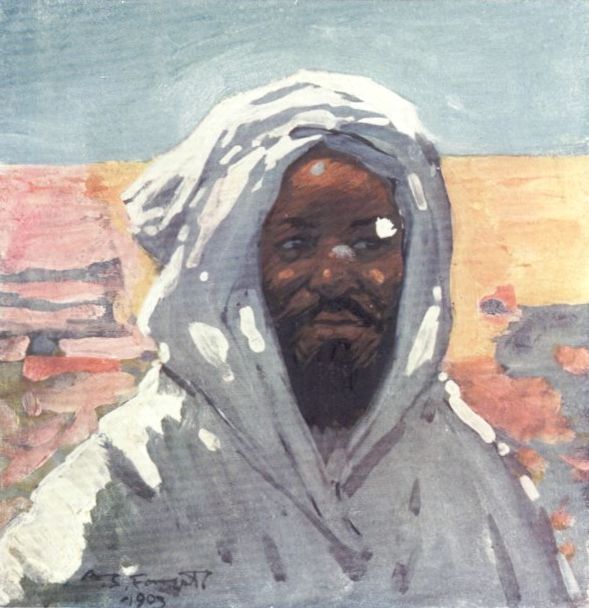
Before we parted, the Hadj, prefacing his remark with renewed assurance of his personal esteem, told me that the country's error had been its admission of strangers. Poor man, his large simple mind could not realise that no power his master held could have kept them out. He told me on another occasion that the great wazeers who had opposed the Sultan's reforms were influenced by fear, lest Western ideas should alter the status of their womenkind. They had heard from all their envoys to Europe how great a measure of liberty is accorded to women, and were prepared to rebel against any reform that might lead to compulsory alteration of the system under which women live—too often as slaves and playthings—in Morocco. My friend's summary of his country's recent history is by no means complete, and, if he could revise it here would doubtless have far more interest. But it seemed advisable to get the Moorish point of view, and, having secured the curious elusive thing, to record it as nearly as might be.
Sidi Boubikir seldom discussed politics. "I am in the South and the trouble is in the North," said he. "Alhamdolillah,[39] I am all for my Lord Abd-el-Aziz. In the reign of his grandfather I made money, when my Lord his father ruled—upon him the Peace—I made money, and now to-day I make money. Shall I listen then to Pretenders and other evil men? The Sultan may have half my fortune."
I did not suggest what I knew to be true, that the Sultan would have been more than delighted to take him at his word, for I remembered the incident of the lampmaker's wager. A considerable knowledge of Moghrebbin Arabic, in combination with hypnotic skill of a high order, would have been required to draw from Boubikir his real opinions of the outlook. Not for nothing was he appointed British political agent in South Morocco. The sphinx is not more inscrutable.
One night his son came to the Dar al Kasdir and brought me an invitation from Sidi Boubikir to dine with him on the following afternoon. Arrived before the gate of his palace at the time appointed, two o'clock, we found the old diplomat waiting to welcome us. He wore a fine linen djellaba of dazzling whiteness, and carried a scarlet geranium in his hand. "You are welcome," he said gravely, and led the way through a long corridor, crying aloud as he went, "Make way, make way," for we were entering the house itself, and it is not seemly that a Moorish woman, whether she be wife or concubine, should look upon a stranger's face. Yet some few lights of the hareem were not disposed to be extinguished altogether by considerations of etiquette, and passed hurriedly along, as though bent upon avoiding us and uncertain of our exact direction. The women-servants satisfied their curiosity openly until my host suddenly commented upon the questionable moral status of their mothers, and then they made haste to disappear, only to return a moment later and peep round corners and doorways, and giggle and scream—as if they had been Europeans of the same class.
Sidi Boubikir passed from room to room of his great establishment and showed some of its treasures. There were great piles of carpets and vast quantities of furniture that must have looked out at one time in their history upon the crowds that throng the Tottenham Court Road; I saw chairs, sofas, bedsteads, clocks, and sideboards, all of English make. Brought on camels through Dukala and R'hamna to Marrakesh, they were left to fill up the countless rooms without care or arrangement, though their owner's house must hold more than fifty women, without counting servants. Probably when they were not quarrelling or dying their finger nails, or painting their faces after a fashion that is far from pleasing to European eyes, the ladies of the hareem passed their days lying on cushions, playing the gimbri[40] or eating sweetmeats.
In one room on the ground-floor there was a great collection of mechanical toys. Sidi Boubikir explained that the French Commercial Attaché had brought a large number to the Sultan's palace, and that my Lord Abd-el-Aziz had rejected the ones before us. With the curious childish simplicity that is found so often among the Moors of high position, Boubikir insisted upon winding up the clock-work apparatus of nearly all the toys. Then one doll danced, another played a drum, a third went through gymnastic exercises, and the toy orchestra played the Marseillaise, while from every adjacent room veiled figures stole out cautiously, as though this room in a Moorish house were a stage and the shrouded visitors were the chorus entering mysteriously from unexpected places. The old man's merriment was very real and hearty, so genuine, in fact, that he did not notice how his women-folk were intruding until the last note sounded. Then he turned round and the swathed figures disappeared suddenly as ghosts at cockcrow.
Though it was clear that Sidi Boubikir seldom saw half the rooms through which we hurried, the passion for building, that seizes all rich Moors, held him fast. He was adding wing after wing to his vast premises, and would doubtless order more furniture from London to fill the new rooms. No Moor knows when it is time to call a halt and deem his house complete, and so the country is full of palaces begun by men who fell from power or died leaving the work unfinished. The Grand Wazeer Ba Ahmad left a palace nearly as big as the Dar el Makhzan itself, and since he died the storks that build upon the flat roofs have been its only occupants. So it is with the gardens, whose many beauties he did not live to enjoy. I rode past them one morning, noted all manner of fruit trees blossoming, heard birds singing in their branches, and saw young storks fishing in the little pools that the rains of winter had left. But there was not one gardener there to tend the ground once so highly cultivated, and I was assured that the terror of the wazeer's name kept even the hungry beggars from the fruit in harvest time.
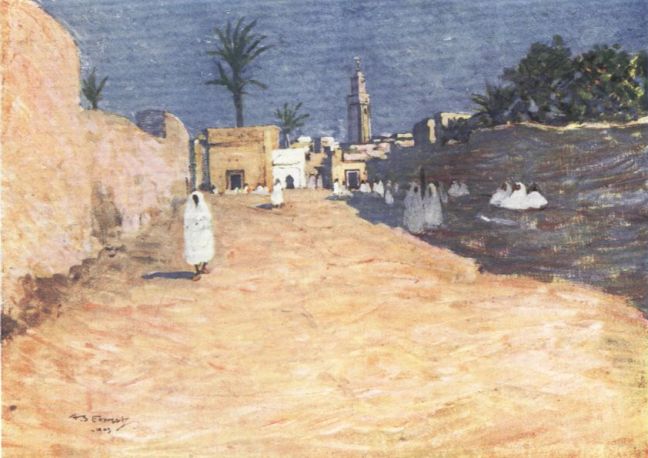
The home and its appointments duly exhibited, Sidi Boubikir led the way to a diwan in a well-cushioned room that opened on to the garden. He clapped his hands and a small regiment of women-servants, black and for the most part uncomely, arrived to prepare dinner. One brought a ewer, another a basin, a third a towel, and water was poured out over our hands. Then a large earthenware bowl encased in strong basketwork was brought by a fourth servant, and a tray of flat loaves of fine wheat by a fifth, and we broke bread and said the "Bismillah,"[41] which stands for grace. The bowl was uncovered and revealed a savoury stew of chicken with sweet lemon and olives, a very pleasing sight to all who appreciate Eastern cooking. The use of knives being a crime against the Faith, and the use of forks and spoons unknown, we plunged the fingers of the right hand into the bowl and sought what pleased us best, using the bread from time to time to deal with the sauce of the stew. It was really a delicious dish, and when later in the afternoon I asked my host for the recipe he said he would give it to me if I would fill the bowl with Bank of England notes. I had to explain that, in my ignorance of the full resources of Moorish cooking, I had not come out with sufficient money.
So soon as the charm of the first bowl palled, it was taken away and others followed in quick succession, various meats and eggs being served with olives and spices and the delicate vegetables that come to Southern Morocco in early spring. It was a relief to come to the end of our duties and, our hands washed once more, to digest the meal with the aid of green tea flavoured with mint. Strong drink being forbidden to the True Believer, water only was served with the dinner, and as it was brought direct from the Tensift River, and was of rich red colour, there was no temptation to touch it. Sidi Boubikir was in excellent spirits, and told many stories of his earlier days, of his dealings with Bashadors, his quarrel with the great kaid Ben Daoud, the siege of the city by certain Illegitimate men—enemies of Allah and the Sultan—his journey to Gibraltar, and how he met one of the Rothschilds there and tried to do business with him. He spoke of his investments in consols and the poor return they brought him, and many other matters of equal moment.
It was not easy to realise that the man who spoke so brightly and lightly about trivial affairs had one of the keenest intellects in the country, that he had the secret history of its political intrigues at his fingers' ends, that he was the trusted agent of the British Government, and lived and throve surrounded by enemies. As far as was consistent with courtesy I tried to direct his reminiscences towards politics, but he kept to purely personal matters, and included in them a story of his attempt to bribe a British Minister,[42] to whom, upon the occasion of the arrival of a British Mission in Marrakesh, he went leading two mules laden with silver. "And when I came to him," said the old man, "I said, 'By Allah's grace I am rich, so I have brought you some share of my wealth.' But he would not even count the bags. He called with a loud voice for his wife, and cried to her, 'See now what this son of shame would do to me. He would give me his miserable money.' And then in very great anger he drove me from his presence and bade me never come near him again bearing a gift. What shall be said of a man like that, to whom Allah had given the wisdom to become a Bashador and the foolishness to reject a present? Two mules, remember, and each one with as many bags of Spanish dollars as it could carry. Truly the ways of your Bashadors are past belief." I agreed heartily with Sidi Boubikir; a day's discourse had not made clear any other aspect of the case.
[27] "In Paradise are rivers of incorruptible water; and rivers of milk, the taste whereof changes not; and rivers of wine, pleasant unto those who drink; and rivers of clarified honey; and in Paradise the faithful shall have all kinds of fruits, and pardon from their God."—Al Koran; Sura 47, "Mohammed."
[28] The late Sir John Drummond Hay, whose name is honourably remembered to this day throughout the Moghreb.
[29] When a Sultan appears in public on a white horse, it is for sign that he is pleased; a black horse, on the other hand, is ominous to them that understand.
[30] Literally "Learned Ones," a theological cabinet, the number of whose members is known to no man, the weight of whose decisions is felt throughout Morocco.
[31] 1873-94.
[32] Hareem.
[33] One of the titles of a Sultan. The "Lofty Portal" ("Sublime Porte") and the "Sublime Presence" are among the others.
[34] Mohammed said: "Every painter is in Hell Fire, and Allah will appoint a person at the day of Resurrection to punish him for every picture he shall have drawn, and he shall be punished in Hell. So, if ye must make pictures, make them of trees and things without souls."
[35] The reader will recognise the Hadj's reference to bicycles, cameras, motor-cars, and other mechanical toys.
[36] Melinite shells.
[37] The stork.
[38] Literally, "Father of the she-ass," the Pretender who conducted a successful campaign against the Sultan in 1902 and 1903, and is still an active enemy of the Filali dynasty.
[39] "The Praise to Allah."
[40] A Moorish lute.
[41] Literally, "In the name of God."
[42] The late Sir William Kirby Green.


/https%3A%2F%2Fassets.over-blog.com%2Ft%2Fcedistic%2Fcamera.png)
/http%3A%2F%2Fdafina.net%2Fgazette%2Fsites%2Fdefault%2Ffiles%2Fimagecache%2F400xY%2Fachoura.jpg)
/http%3A%2F%2Fwww.telexpresse.com%2Fimagesnews%2F1351245014.jpg)
/http%3A%2F%2Fwww.aufaitmaroc.com%2Fpictures%2F0089%2F1057%2Fsimon_levy_07122011160839_medium.jpg%3F1323281718)
