

/fdata%2F2453167%2Favatar-blog-1073688003-tmpphpuHSn6z.jpeg)
LIVRE:The Project Gutenberg EBook of Morocco, by S.L. Bensusan
-7- SUITE
atures—quite childlike in many of their peculiarities.
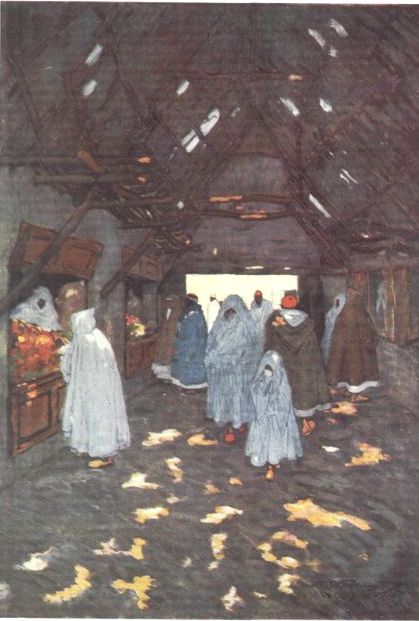
The desert caravan trade is not what it was since the French occupied Timbuctoo and closed the oases of Tuat; but I saw some caravans arrive from the interior—one of them from the sandy region where Mons. Lebaudy has set up his kingdom. How happy men and beasts seemed to be. I never saw camels looking so contented: the customary sneer had passed from their faces—or accumulated dust had blotted it out. On the day when the market is held in the open place beyond the Bab al Khamees, there is another big gathering within the city walls by the Jamáa Effina. Here acrobats and snake-charmers and story-tellers ply their trade, and never fail to find an audience. The acrobats come from Tarudant and another large city of the Sus that is not marked in the British War Office Map of Morocco dated 1889! Occasionally one of these clever tumblers finds his way to London, and is seen at the music halls there.
I remember calling on one Hadj Abdullah when I was in the North, and to my surprise he told me he spoke English, French, German, Spanish, Turkish, Moghrebbin Arabic, and Shilha. "I know London well," he said; "I have an engagement to bring my troupe of acrobats to the Canterbury and the Oxford. I am a member of a Masonic Lodge in Camberwell." Commonplace enough all this, but when you have ridden out of town to a little Moorish house on the hillside overlooking the Mediterranean, and are drinking green tea flavoured with mint, on a diwan that must be used with crossed legs, you hardly expect the discussion to be turned to London music-halls.
Snake-charmers make a strong appeal to the untutored Moorish crowd. Black cobras and spotted leffa snakes from the Sus are used for the performance. When the charmer allows the snakes to dart at him or even to bite, the onlookers put their hands to their foreheads and praise Sidi ben Aissa, a saint who lived in Mequinez when Mulai Ismail ruled, a pious magician whose power stands even to-day between snake-charmers and sudden death. The musician who accompanies the chief performer, and collects the floos offered by spectators, works his companion into a condition of frenzy until he does not seem to feel the teeth of the snakes; but as people who should be well informed declare that the poison bags are always removed before the snakes are used for exhibition, it is hard for the mere Unbeliever to render to Sidi ben Aissa the exact amount of credit that may be due to him.
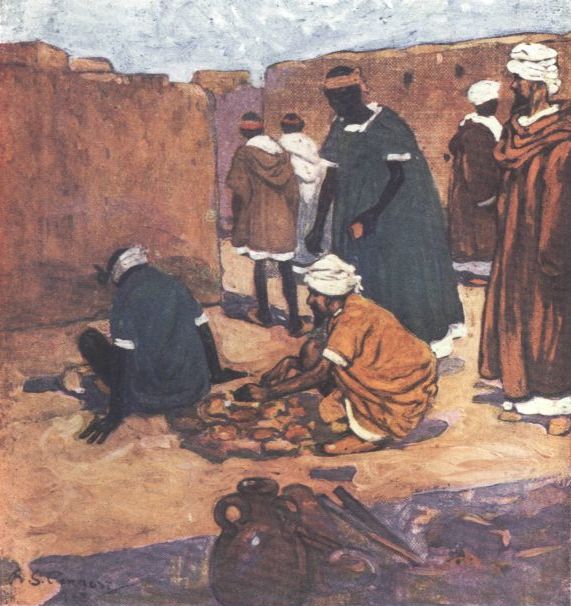
The story-teller, whose legends are to be found in the "Thousand Nights and a Night," is generally a merry rogue with ready wit. His tales are told with a wealth of detail that would place them upon the index expurgatorius of the Western world, but men, women, and children crowd round to hear them, and if his tale lacks the ingredients most desired they do not hesitate to tell him so, whereupon he will respond at once to his critics, and add love or war in accordance with their instructions. One has heard of something like this in the serial market at home. His reward is scanty, like that of his fellow-workers, the acrobat and the snake charmer, but he has quite a professional manner, and stops at the most exciting points in his narrative for his companion to make a tour of the circle to collect fees. The quality of the adventures he retails is settled always by the price paid for them.
It is a strange sight, and unpleasant to the European, who believes that his morality, like his faith, is the only genuine article, to see young girls with antimony on their eyelids and henna on their nails, listening to stories that only the late Sir Richard Burton dared to render literally into the English tongue. While these children are young and impressionable they are allowed to run wild, but from the day when they become self-conscious they are strictly secluded.
Throughout Marrakesh one notes a spirit of industry. If a man has work, he seems to be happy and well content. Most traders are very courteous and gentle in their dealings, and many have a sense of humour that cannot fail to please. While in the city I ordered one or two lamps from a workman who had a little shop in the Madinah. He asked for three days, and on the evening of the third day I went to fetch them, in company with Salam. The workman, who had made them himself, drew the lamps one by one from a dark corner, and Salam, who has a hawk's eye, noticed that the glass of one was slightly cracked.
"Have a care, O Father of Lamps," he said; "the Englishman will not take a cracked glass."
"What is this," cried the Lamps' Father in great anger, "who sells cracked lamps? If there is a flaw in one of mine, ask me for two dollars."
Salam held the lamp with cracked glass up against the light. "Two dollars," he said briefly. The tradesman's face fell. He put his tongue out and smote it with his open hand.
"Ah," he said mournfully, when he had admonished the unruly member, "who can set a curb upon the tongue?"[26]
[24] Mulai Rashed II.
[25] The royal umbrella.
[26] Cf. James iii. 8. But for a mere matter of dates, one would imagine that Luther detected the taint of Islam in James when he rejected his Epistle.
THE SLAVE MARKET AT MARRAKESH
CHAPTER VII
As to your slaves, see that ye feed them with such food as ye eat yourselves, and clothe them with the stuff ye wear. And if they commit a fault which ye are not willing to forgive, then sell them, for they are the servants of Allah, and are not to be tormented.
—Mohammed's last Address.
In the bazaars of the brass-workers and dealers in cotton goods, in the bazaars of the saddlers and of the leather-sellers,—in short, throughout the Kaisariyah, where the most important trade of Marrakesh is carried on,—the auctions of the afternoon are drawing to a close. The dilals have carried goods to and fro in a narrow path between two lines of True Believers, obtaining the best prices possible on behalf of the dignified merchants, who sit gravely in their boxlike shops beyond the reach of toil. No merchant seeks custom: he leaves the auctioneers to sell for him on commission, while he sits at ease, a stranger to elation or disappointment, in the knowledge that the success or failure of the day's market is decreed. Many articles have changed hands, but there is now a greater attraction for men with money outside the limited area of the Kaisariyah, and I think the traffic here passes before its time.
The hour of the sunset prayer is approaching. The wealthier members of the community leave many attractive bargains unpursued, and, heedless of the dilals' frenzied cries, set out for the Sok el Abeed. Wool market in the morning and afternoon, it becomes the slave market on three days of the week, in the two hours that precede the setting of the sun and the closing of the city gates; this is the rule that holds in Red Marrakesh.
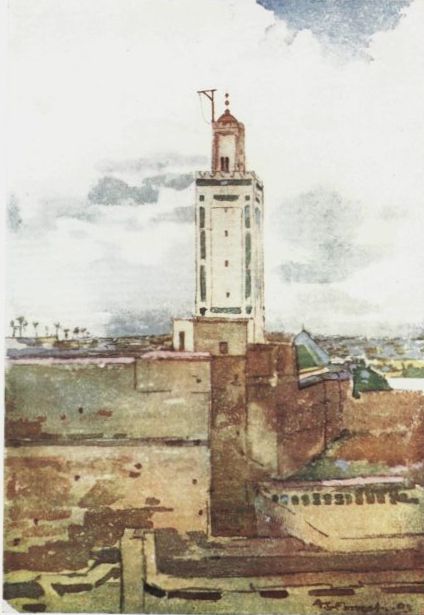
I follow the business leaders through a very labyrinth of narrow, unpaved streets, roofed here and there with frayed and tattered palmetto-leaves that offer some protection, albeit a scanty one, against the blazing sun. At one of the corners where the beggars congregate and call for alms in the name of Mulai Abd el Kader Ijjilalli, I catch a glimpse of the great Kutubia tower, with pigeons circling round its glittering dome, and then the maze of streets, shutting out the view, claims me again. The path is by way of shops containing every sort of merchandise known to Moors, and of stalls of fruit and vegetables, grateful "as water-grass to herds in the June days." Past a turning in the crowded thoroughfare, where many Southern tribesmen are assembled, and heavily-laden camels compel pedestrians to go warily, the gate of the slave market looms portentous.
A crowd of penniless idlers, to whom admittance is denied, clamours outside the heavy door, while the city urchins fight for the privilege of holding the mules of wealthy Moors, who are arriving in large numbers in response to the report that the household of a great wazeer, recently disgraced, will be offered for sale. One sees portly men of the city wearing the blue cloth selhams that bespeak wealth, country Moors who boast less costly garments, but ride mules of easy pace and heavy price, and one or two high officials of the Dar el Makhzan. All classes of the wealthy are arriving rapidly, for the sale will open in a quarter of an hour.
The portals passed, unchallenged, the market stands revealed—an open space of bare, dry ground, hemmed round with tapia walls, dust-coloured, crumbling, ruinous. Something like an arcade stretches across the centre of the ground from one side to the other of the market. Roofless now and broken down, as is the outer wall itself, and the sheds, like cattle pens, that are built all round, it was doubtless an imposing structure in days of old. Behind the outer walls the town rises on every side. I see mules and donkeys feeding, apparently on the ramparts, but really in a fandak overlooking the market. The minaret of a mosque rises nobly beside the mules' feeding-ground, and beyond there is the white tomb of a saint, with swaying palm trees round it. Doubtless this zowia gives the Sok el Abeed a sanctity that no procedure within its walls can besmirch; and, to be sure, the laws of the saint's religion are not so much outraged here as in the daily life of many places more sanctified by popular opinion.
On the ground, by the side of the human cattle pens, the wealthy patrons of the market seat themselves at their ease, arrange their djellabas and selhams in leisurely fashion, and begin to chat, as though the place were the smoking-room of a club. Water-carriers—lean, half-naked men from the Sus—sprinkle the thirsty ground, that the tramp of slaves and auctioneers may not raise too much dust. Watching them as they go about their work, with the apathy born of custom and experience, I have a sudden reminder of the Spanish bull-ring, to which the slave market bears some remote resemblance. The gathering of spectators, the watering of the ground, the sense of excitement, all strengthen the impression. There are no bulls in the torils, but there are slaves in the pens. It may be that the bulls have the better time. Their sufferings in life are certainly brief, and their careless days are very long drawn out. But I would not give the impression that the spectators here are assembled for amusement, or that my view of some of their proceedings would be comprehensible to them. However I may feel, the other occupants of this place are here in the ordinary course of business, and are certainly animated by no such fierce passions as thrill through the air of a plaza de toros. I am in the East but of the West, and "never the twain shall meet."
Within their sheds the slaves are huddled together. They will not face the light until the market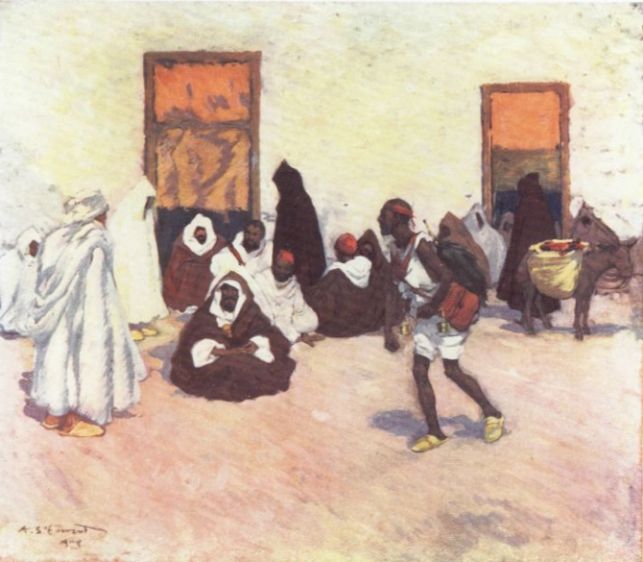


/https%3A%2F%2Fassets.over-blog.com%2Ft%2Fcedistic%2Fcamera.png)
/http%3A%2F%2Fdafina.net%2Fgazette%2Fsites%2Fdefault%2Ffiles%2Fimagecache%2F400xY%2Fachoura.jpg)
/http%3A%2F%2Fwww.telexpresse.com%2Fimagesnews%2F1351245014.jpg)
/http%3A%2F%2Fwww.aufaitmaroc.com%2Fpictures%2F0089%2F1057%2Fsimon_levy_07122011160839_medium.jpg%3F1323281718)
