

/fdata%2F2453167%2Favatar-blog-1073688003-tmpphpuHSn6z.jpeg)
LIVRE:The Project Gutenberg EBook of Morocco, by S.L. Bensusan
The Project Gutenberg EBook of Morocco, by S.L. Bensusan


This eBook is for the use of anyone anywhere at no cost and with

almost no restrictions whatsoever.  You may copy it, give it away or

re-use it under the terms of the Project Gutenberg License included

with this eBook or online at www.gutenberg.net


Title: Morocco


Author: S.L. Bensusan


Illustrator: A.S. Forrest


Release Date: August 13, 2005 [EBook #16526]


Language: English


Character set encoding: ISO-8859-1


*** START OF THIS PROJECT GUTENBERG EBOOK MOROCCO ***


Produced by Juliet Sutherland, Melissa Er-Raqabi and the

Online Distributed Proofreading Team at http://www.pgdp.net.
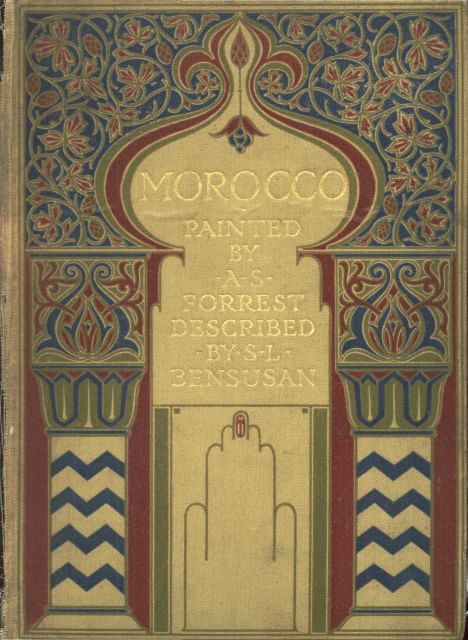
painted by
A.S. FORREST
described by
S.L. BENSUSAN
| The following apparent printer's errors were changed: |
| from appearonce to appearance |
| from everthing to everything |
| from kindgom to kingdom |
| from "Tuesday market. to "Tuesday market." |
| Other inconsistencies in spelling have been left as in the original. |
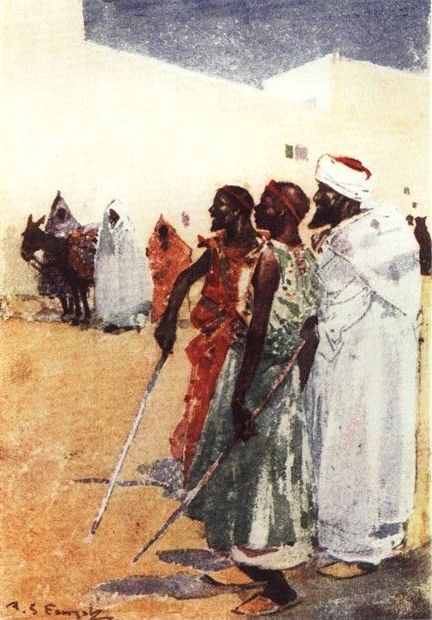
painted by
A.S. FORREST
described by
S.L. BENSUSAN
LONDON
ADAM AND CHARLES BLACK
1904
"As I have felt, so I have written."
Eōthen.
Preface
It has been a pleasant task to recall the little journey set out in the following pages, but the writer can hardly escape the thought that the title of the book promises more than he has been able to perform. While the real Morocco remains a half-known land to-day, this book does not take the traveller from the highroad. The mere idler, the wayfarer to whom Morocco is no more than one of many places of pilgrimage, must needs deal modestly with his task, even though modesty be an unfashionable virtue; and the painstaking folk who pass through this world pelting one another with hard facts will find here but little to add to their store of ammunition. This appeal is of set purpose a limited one, made to the few who are content to travel for the sake of the pleasures of the road, free from the comforts that beset them at home, and free also from the popular belief that their city, religion, morals, and social laws are the best in the world. The qualifications that fit a man to make money and acquire the means for modern travel are often fatal to proper appreciation of the unfamiliar world he proposes to visit. To restore the balance of things, travel agents and other far-seeing folks have contrived to inflict upon most countries within the tourist's reach all the modern conveniences by which he lives and thrives. So soon as civilising missions and missionaries have pegged out their claims, even the desert is deemed incomplete without a modern hotel or two, fitted with electric light, monstrous tariff, and served by a crowd of debased guides. In the wake of these improvements the tourist follows, finds all the essentials of the life he left at home, and, knowing nothing of the life he came to see, has no regrets. So from Algiers, Tunis, Cairo—ay, even from Jerusalem itself, all suggestion of great history has passed, and one hears among ruins, once venerable, the globe-trotter's cry of praise. "Hail Cook," he cries, as he seizes the coupons that unveil Isis and read the riddle of the Sphinx, "those about to tour salute thee."
But of the great procession that steams past Gibraltar, heavily armed with assurance and circular tickets, few favour Morocco at all, and the most of these few go no farther than Tangier. Once there, they descend upon some modern hotel, often with no more than twenty-four hours in which to master the secrets of Sunset Land.
After dinner a few of the bolder spirits among the men take counsel of a guide, who leads them to the Moorish coffee-house by the great Mosque. There they listen to the music of ghaitah and gimbri, pay a peseta for a cup of indifferent coffee, and buy an unmusical instrument or two for many times the proper price. Thereafter they retire to their hotel to consider how fancy can best embellish the bare facts of the evening's amusement, while the True Believers of the coffee-house (debased in the eyes of all other Believers, and, somewhat, too, in fact, by reason of their contact with the Infidel) gather up the pesetas, curse the Unbeliever and his shameless relations, and praise Allah the One who, even in these degenerate days, sends them a profit.
On the following morning the tourists ride on mules or donkeys to the showplaces of Tangier, followed by scores of beggar boys. The ladies are shown over some hareem that they would enter less eagerly did they but know the exact status of the odalisques hired to meet them. One and all troop to the bazaars, where crafty men sit in receipt of custom and relieve the Nazarene of the money whose value he does not know. Lunch follows, and then the ship's siren summons the travellers away from Morocco, to speak and write with authority for all time of the country and its problems.
With these facts well in mind, it seemed best for me to let the pictures suffice for Tangier, and to choose for the text one road and one city. For if the truth be told there is little more than a single path to all the goals that the undisguised European may reach.
Morocco does not change save by compulsion, and there is no area of European influence below Tangier. Knowing one highway well you know something of all; consequently whether Fez, Mequinez, Wazzan, or Marrakesh be the objective, the travel story does not vary greatly. But to-day, Marrakusha-al-Hamra, Red Marrakesh, is the most African of all cities in Morocco, and seemed therefore best suited to the purpose of this book. Moreover, at the time when this journey was made, Bu Hamara was holding the approaches to Fez, and neither Mequinez nor Wazzan was in a mood to receive strangers.
So it falls out that the record of some two or three hundred miles of inland travel is all that awaits the reader here. In time to come, when Morocco has been purged of its offences of simplicity and primitiveness, the tourist shall accomplish in forty-eight hours the journey that demanded more than a month of last year's spring. For Sunset Land has no railway lines, nor can it boast—beyond the narrow limits of Tangier—telegraphs, telephones, electric light, modern hotels, or any of the other delights upon which the pampered traveller depends. It is as a primeval forest in the hour before the dawn. When the sun of France penetrates pacifically to all its hidden places, the forest will wake to a new life. Strange birds of bright plumage, called in Europe gens d'armes, will displace the storks upon the battlements of its ancient towns, the commis voyageur will appear where wild boar and hyæna now travel in comparative peace, the wild cat (felis Throgmortonensis) will arise from all mineralised districts. Arab and Berber will disappear slowly from the Moroccan forest as the lions have done before them, and in the place of their douars and ksor there shall be a multitude of small towns laid out with mathematical precision, reached by rail, afflicted with modern improvements, and partly filled with Frenchmen who strive to drown in the café their sorrow at being so far away from home. The real Morocco is so lacking in all the conveniences that would commend it to wealthy travellers that the writer feels some apology is due for the appearance of his short story of an almost unknown country in so fine a setting. Surely a simple tale of Sunset Land was never seen in such splendid guise before, and will not be seen again until, with past redeemed and forgotten, future assured, and civilisation modernised, Morocco ceases to be what it is to-day.
S.L. BENSUSAN.
July 1904.
Contents
| CHAPTER I | page |
| By Cape Spartel | 3 |
| CHAPTER II | |
| From Tangier to Djedida | 21 |
| CHAPTER III | |
| On the Moorish Road | 41 |
| CHAPTER IV | |
| To the Gates of Marrakesh | 57 |
| CHAPTER V | |
| In Red Marrakesh | 77 |
| CHAPTER VI | |
| Round about Marrakesh | 101 |
| CHAPTER VII | |
| The Slave Market at Marrakesh | 121 |
| CHAPTER VIII | |
| Green Tea and Politics | 139 |
| CHAPTER IX | |
| Through a Southern Province | 159 |
| CHAPTER X | |
| "Sons of Lions" | 179 |
| CHAPTER XI | |
| In the Argan Forest | 199 |
| CHAPTER XII | |
| To the Gate of the Picture City | 217 |
List of Illustrations
The Illustrations in this volume have been engraved in England by the Hentschel Colourtype Process.


/https%3A%2F%2Fassets.over-blog.com%2Ft%2Fcedistic%2Fcamera.png)
/http%3A%2F%2Fdafina.net%2Fgazette%2Fsites%2Fdefault%2Ffiles%2Fimagecache%2F400xY%2Fachoura.jpg)
/http%3A%2F%2Fwww.telexpresse.com%2Fimagesnews%2F1351245014.jpg)
/http%3A%2F%2Fwww.aufaitmaroc.com%2Fpictures%2F0089%2F1057%2Fsimon_levy_07122011160839_medium.jpg%3F1323281718)
